

A Client Manager resignation letter is a formal document. It informs your employer of your decision to leave your position. The purpose is to officially announce your departure and state your last working day. It’s a crucial step in ending your employment professionally.
Deciding to move on is a big step. Writing the resignation letter can be tricky. We’ve got you covered. We’re sharing templates and examples. They are designed specifically for Client Managers.
These samples will make things easy. Use them to create your own personalized letter. Adapt the language to your specific situation. Craft a letter that reflects your experience.
Client Manager Resignation Letter
Below is a sample of a Client Manager Resignation Letter:
[Your Name]
[Your Address]
[Your Phone Number]
[Your Email Address]
[Date]
[Client Manager’s Name]
[Client Manager’s Title]
[Company Name]
[Company Address]
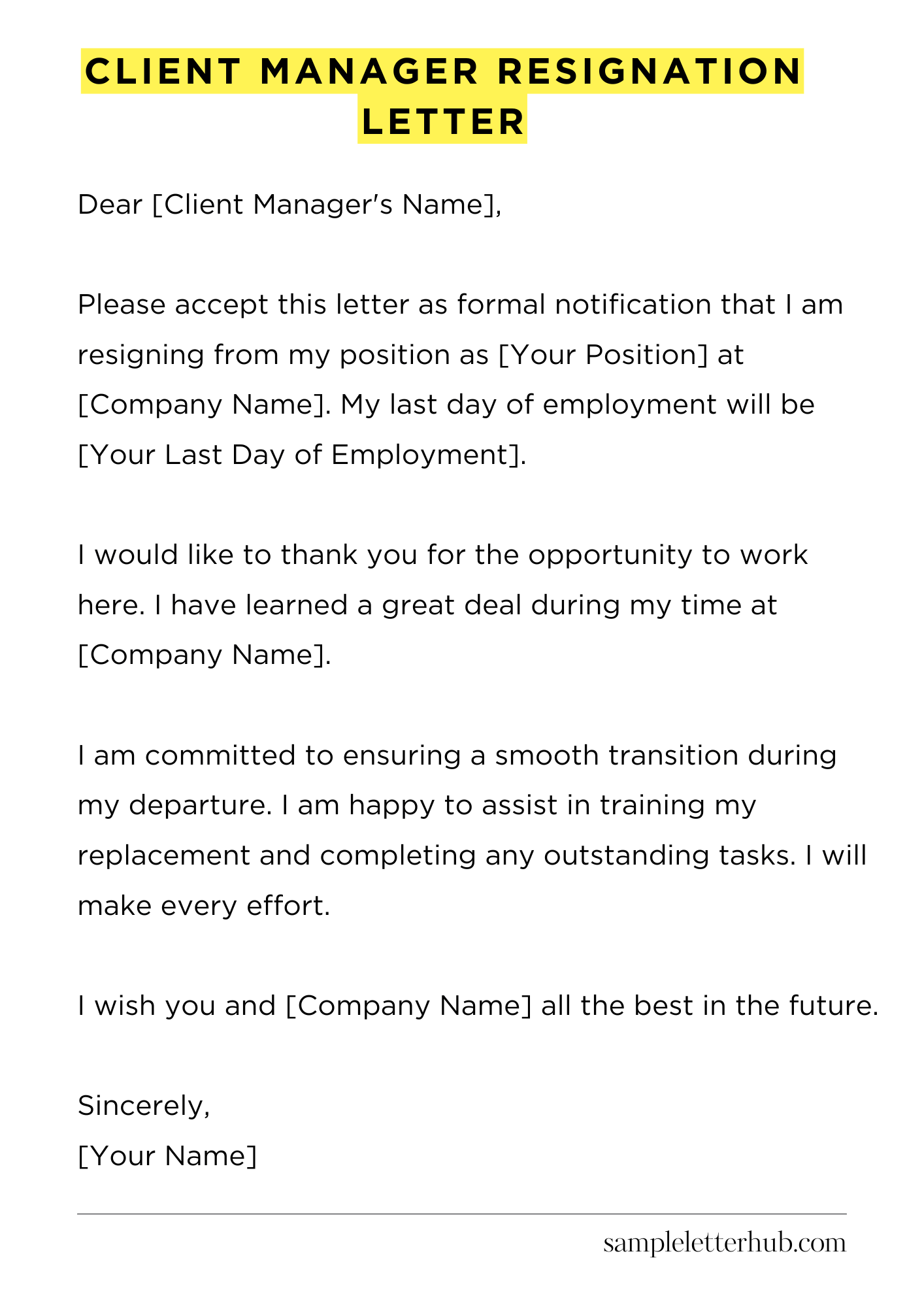
Dear [Client Manager’s Name],
Please accept this letter as formal notification that I am resigning from my position as [Your Position] at [Company Name]. My last day of employment will be [Your Last Day of Employment].
I would like to thank you for the opportunity to work here. I have learned a great deal during my time at [Company Name].
I am committed to ensuring a smooth transition during my departure. I am happy to assist in training my replacement and completing any outstanding tasks. I will make every effort to hand over my responsibilities effectively.
I wish you and [Company Name] all the best in the future.
Sincerely,
[Your Name]
How to Write a Client Manager Resignation Letter
1. Preparation is Key: Before You Start
Resigning from any job is a big step, and it requires careful planning. You’re leaving a role, and you want to do it professionally. Before you even think about penning your resignation, take some time to reflect.
Why are you leaving? Are you taking another job? What’s your desired departure date? These are crucial questions. Knowing the answers will help you tailor your letter. Consider your company’s policies regarding resignation.
Check your employment contract. Familiarize yourself with how they expect you to deliver your notice. This helps avoid any potential issues. This preparation ensures a smooth transition.
2. Structure and Format: Laying the Groundwork
Your resignation letter needs a clear, professional structure. Start with a formal salutation. Address your letter to your immediate supervisor or HR representative. Next, state your intention to resign clearly.
Be direct and concise. Avoid beating around the bush. Following this, specify your last day of employment. This is essential for the company’s records and planning. Always be polite. Keep a neutral tone.
This helps maintain a positive relationship. Avoid negativity or complaints. Remember, you might need a reference in the future.
3. Content Matters: What to Include
Beyond the basics, certain elements add weight to your letter. Express your gratitude for the opportunity. Briefly mention the skills or experiences gained during your employment.
This demonstrates professionalism. You might offer assistance during the transition period. For example, offering to train your replacement. This shows you care about the success of the company.
Keep the letter short and focused. Avoid lengthy explanations or justifications for your departure. A simple, well-crafted letter is often the most effective.
4. The Tone and Language: Choosing Your Words Wisely
The language you use significantly impacts how your letter is received. Maintain a professional tone throughout. Avoid slang, jargon, or overly casual language. Focus on facts.
Acknowledge your resignation and express gratitude. Be sincere. Avoid being overly emotional or dramatic. Keep it concise. Edit your letter carefully. Proofread it for any grammatical errors or typos. Ensure the letter reflects positively on your professionalism. This is the last thing your employer will see, so make it count.
5. After Submission: Following Up
Once you have submitted your letter, consider your work done. Do not forget to keep a copy for your records. You might be asked to discuss your resignation in person. Be prepared for this.
Always remain professional and respectful in any subsequent conversations. After you leave, follow through with any commitments you made, like helping with the transition. Maintaining a positive relationship, even after leaving, is beneficial. It is a small world after all.
FAQs about Client Manager resignation letter
How do I start a Client Manager resignation letter?
Begin your resignation letter professionally. Start with a clear and concise statement of your intent to resign, including your name, the date, and the effective date of your resignation. Address the letter to your immediate supervisor or the appropriate person within the company.
What key information should be included in a Client Manager resignation letter?
Your resignation letter should contain:
- A formal statement of resignation.
- The specific date your employment will end (your last day).
- A brief expression of gratitude for the opportunity.
- A concise reason for your departure (optional, but often included).
- An offer to assist with the transition of your duties.
- Your contact information for future communication (optional).
Is it necessary to provide a reason for resigning in the letter?
Providing a reason for your resignation is optional. However, it’s often courteous to include a brief, neutral explanation, such as “to pursue other opportunities” or “to focus on personal development.” Keep it positive and avoid negative comments about the company or colleagues.
How should I handle the transition of my client responsibilities?
Offer to assist with the handover of your client accounts and responsibilities. This demonstrates professionalism and a commitment to ensuring a smooth transition. Be specific about the assistance you can provide, such as documenting client information, training a replacement, or attending handover meetings.
Should I mention any potential conflicts of interest in my resignation letter?
Generally, it’s not necessary to mention potential conflicts of interest in your resignation letter unless you are contractually obligated to do so. If you have concerns, it’s usually best to discuss them separately with your manager or HR department. Be aware of any non-compete agreements you may have signed.
Related:
Resignation letter due to rude boss
Resignation letter moving to another state
Resignation letter due to illness of family member
Resignation letter due to study