

A faculty member resignation letter is a formal document. It announces a professor’s or instructor’s departure from a university or college. The primary purpose is to officially notify the institution of the resignation. It also often includes the effective date of leaving.
Writing a resignation letter can be tricky. We want to make it easy for you. You will find different samples here. We have included various templates and examples. These are designed to help you.
We have considered different scenarios. Consider these as your guides. Adapt them to fit your unique situation. Craft your letter with confidence and clarity.
Faculty Member Resignation Letter
Below is a sample of a Faculty Member Resignation Letter:
[Your Name]
[Your Address]
[Your Phone Number]
[Your Email Address]
[Date]
[Hiring Manager Name] (If known, otherwise use title)
[Hiring Manager Title]
[Department Name]
[University/Institution Name]
[University/Institution Address]
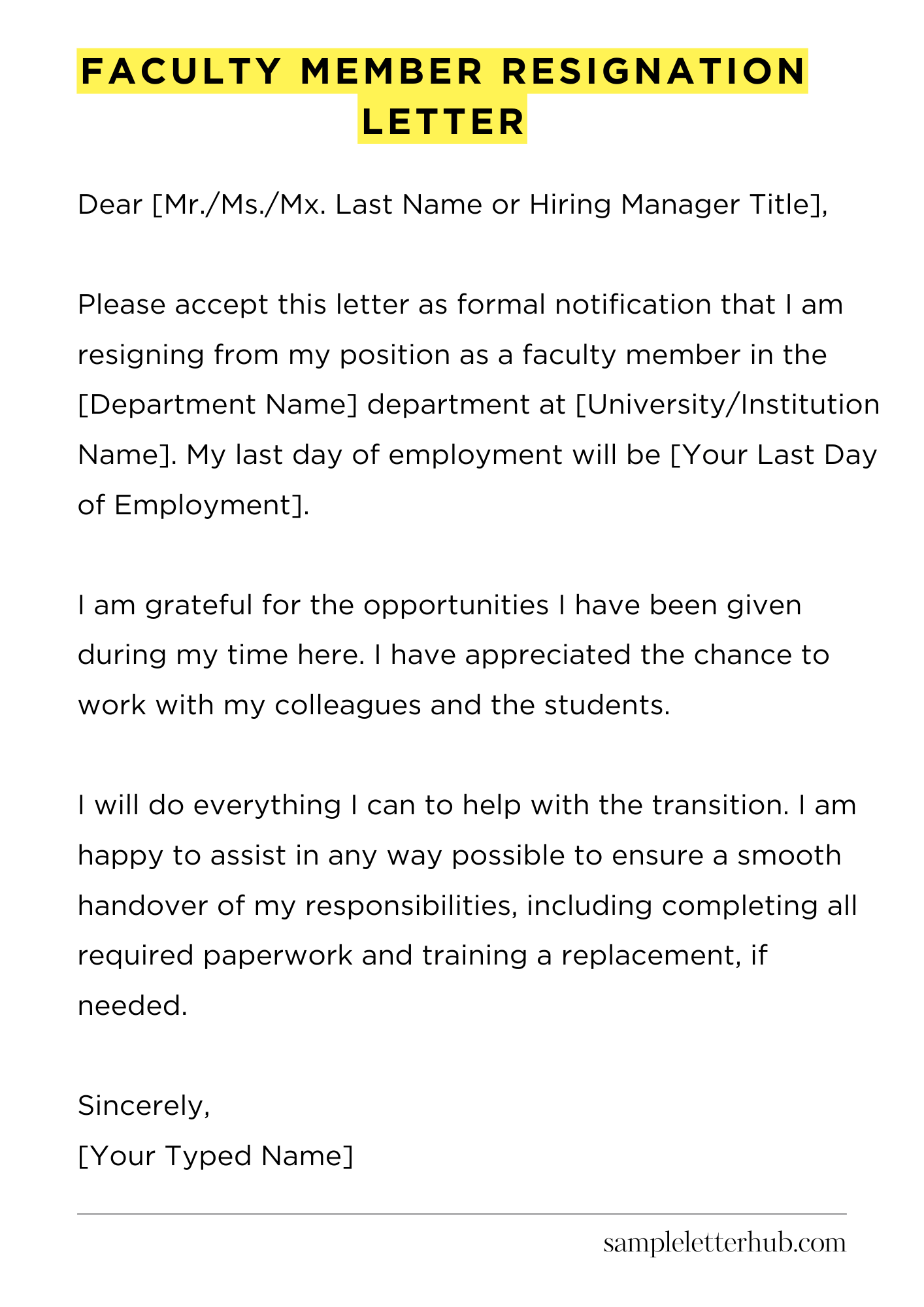
Dear [Mr./Ms./Mx. Last Name or Hiring Manager Title],
Please accept this letter as formal notification that I am resigning from my position as a faculty member in the [Department Name] department at [University/Institution Name]. My last day of employment will be [Your Last Day of Employment].
I am grateful for the opportunities I have been given during my time here. I have appreciated the chance to work with my colleagues and the students.
I will do everything I can to help with the transition. I am happy to assist in any way possible to ensure a smooth handover of my responsibilities, including completing all required paperwork and training a replacement, if needed.
I wish you and the university all the best in the future.
Sincerely,
[Your Typed Name]
How to Write a Faculty Member Resignation Letter
Resigning from a faculty position is a big decision. It’s important to do it correctly. This ensures a smooth transition. Also, it protects your professional reputation. Writing a well-crafted resignation letter is the first crucial step. This guide provides a clear roadmap. It helps you navigate this process effectively.
1. Start with a Clear and Direct Statement
Your letter should begin with a direct statement of your intent. State that you are resigning from your position. Include the specific title of your role, such as “Associate Professor of History.” Mention the department you are leaving. Make it clear and concise, right from the start.
For example, you could write: “Please accept this letter as formal notification that I am resigning from my position as Assistant Professor of Biology in the Department of Biological Sciences at [University Name].” A strong start is key. You’ve clearly stated your purpose. This sets the tone for the rest of the letter.
2. Provide the Effective Date
Clearly state your last day of employment. This is crucial for HR and the department to prepare for your departure. Refer to your employment contract. Double-check your contractual obligations regarding notice periods. Generally, this is a month or two. Be sure to align your date with these requirements.
Consider something like: “My last day of employment will be [Date], two months from today, in accordance with the university’s policy.” This avoids any potential misunderstandings. It demonstrates your professionalism.
3. Express Gratitude and Acknowledge Contributions
Even if you’re leaving for positive reasons, expressing gratitude is always a good idea. Acknowledge the opportunities you’ve been given. Briefly mention any positive experiences or accomplishments during your tenure. This shows respect for the institution and the people you’ve worked with. It also maintains a positive image.
You might write: “I am grateful for the opportunities I have received during my [Number] years at [University Name]. I have valued my time teaching and conducting research within the Department of [Department Name]. I would like to specifically thank [Name of person] and [Name of person]. Their support has been invaluable.
4. Offer Assistance with the Transition
Showing willingness to help with the transition demonstrates professionalism and consideration. Offer to assist in any way you can. This might include training a replacement, providing notes, or helping with ongoing projects. Be specific about what you’re offering. This also gives the university assurance that your departure is amicable.
Here’s an example: “I am happy to assist with the transition. I am available to help with the handover of my responsibilities, including [specific task]. I will also be available for consultations during the handover phase.” A small gesture can go a long way.
5. Formal Closing and Contact Information
Conclude your letter with a formal closing. Use phrases like “Sincerely,” “Respectfully,” or “Best regards.” Include your full name, printed below the closing. Be sure to list your contact information. This includes your email address and any other contact information you wish to provide. This helps with future communication regarding benefits or outstanding issues.
For example: “Sincerely, [Your Full Name] [Your Email Address] [Your Phone Number (Optional)]” Proofread your letter carefully before submitting it. Make sure it reflects positively on you and your career.
FAQs about Faculty Member resignation letter
How much notice should a faculty member give when resigning?
The standard notice period for faculty members varies depending on the institution’s policies, the employment contract, and the specific academic rank. However, a common expectation is at least one to two months’ notice.
Senior faculty members or those in leadership positions may be expected to provide more notice, potentially up to three months. The best approach is to carefully review the employment contract and consult with the department chair or human resources to determine the specific requirements.
What essential information should be included in a faculty member’s resignation letter?
A faculty member’s resignation letter should include the following essential information: a clear and formal statement of resignation, the effective date of resignation, a brief expression of gratitude for the opportunity to have worked at the institution, and any specific details required by the institution, such as the return of university property.
The letter should be addressed to the appropriate authority, usually the department chair or the dean, and should be professionally written and free of any negative or critical comments.
Should a faculty member provide a reason for their resignation in the letter?
While not always required, it is generally acceptable and often advisable to provide a brief, professional reason for resigning in the letter. This could simply be to pursue other opportunities or to relocate.
A more detailed explanation is not usually necessary or expected. Keeping the reason concise and positive helps maintain a professional tone and can prevent any unnecessary complications.
How should a faculty member handle the return of university property and other responsibilities after submitting their resignation?
After submitting a resignation letter, a faculty member should follow all university guidelines regarding the return of property such as keys, ID cards, and any materials that belong to the university.
They should also cooperate in the transfer of responsibilities, including research projects, course materials, and student advising. This includes any necessary documentation, and training for the faculty member taking over these duties. Adhering to these obligations demonstrates professionalism and facilitates a smooth transition for the university.
What are the potential legal and ethical considerations faculty members should be aware of when resigning?
Faculty members should be aware of several legal and ethical considerations when resigning. These may include clauses in their employment contract regarding non-compete agreements, intellectual property rights, and confidentiality of research data.
They should ensure they are not breaching any ethical guidelines regarding conflicts of interest or the unauthorized use of university resources or data. Consulting with legal counsel or the university’s human resources department can help faculty members navigate these complexities.
Related:
Resignation letter due to rude boss
Resignation letter moving to another state
Resignation letter due to illness of family member
Resignation letter due to study