

An Interior Architect resignation letter is a formal document. It informs your employer of your intention to leave your job. The letter officially states your last day of employment. It’s a crucial step in ending your professional relationship.
Planning to resign? Need help writing your letter? We’ve got you covered. This article offers several letter samples. You can use them as a starting point. Tailor them to fit your specific situation.
These examples cover different scenarios. From basic to more complex resignations. They’ll guide you in crafting your own professional letter. Let’s get started and make your exit smoother!
Interior Architect Resignation Letter
Below is a sample of a Interior Architect Resignation Letter:
[Your Name]
[Your Address]
[Your Phone Number]
[Your Email Address]
[Date]
[Employer’s Name]
[Employer’s Title]
[Company Name]
[Company Address]
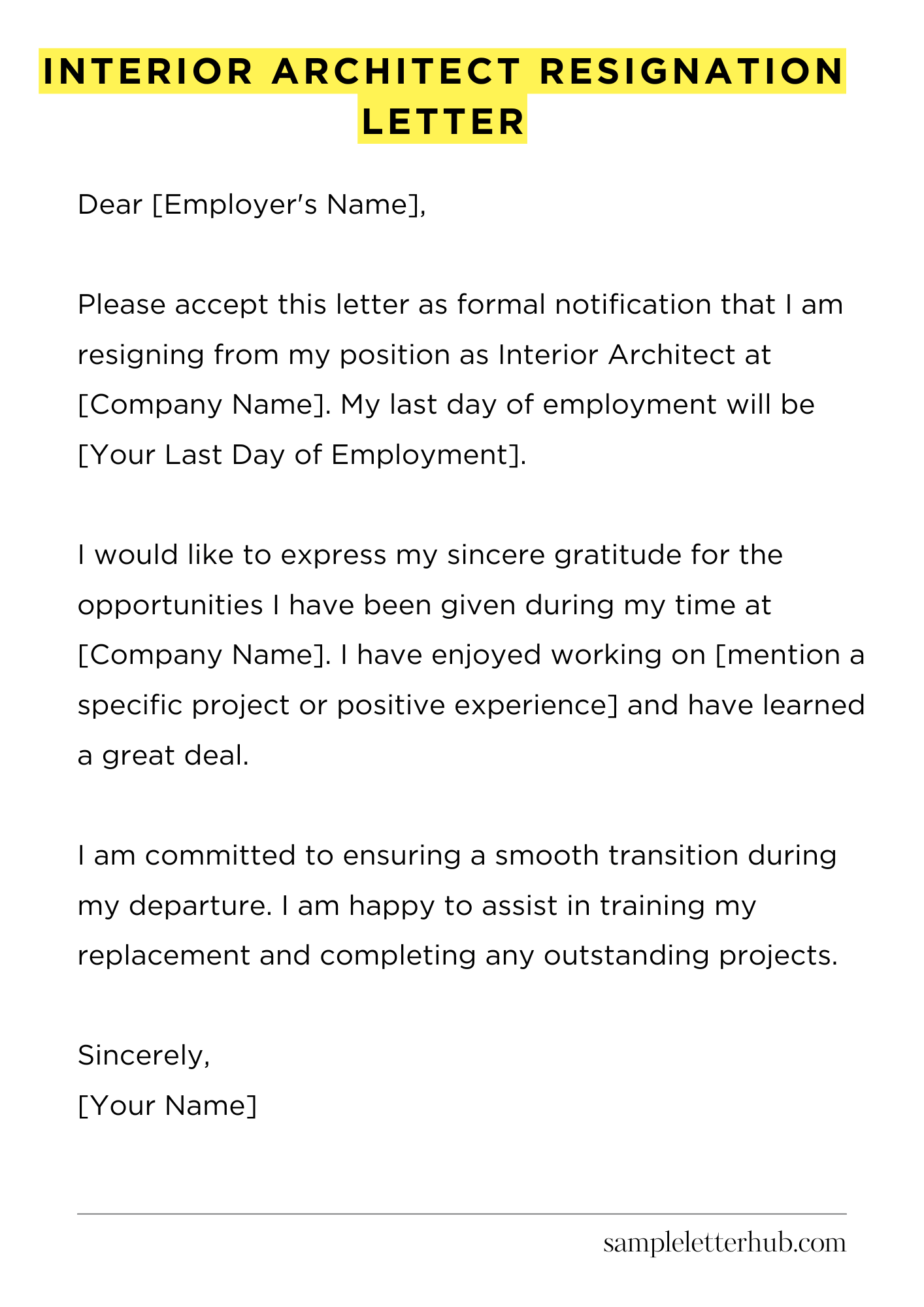
Dear [Employer’s Name],
Please accept this letter as formal notification that I am resigning from my position as Interior Architect at [Company Name]. My last day of employment will be [Your Last Day of Employment].
I would like to express my sincere gratitude for the opportunities I have been given during my time at [Company Name]. I have enjoyed working on [mention a specific project or positive experience] and have learned a great deal.
I am committed to ensuring a smooth transition during my departure. I am happy to assist in training my replacement and completing any outstanding projects. Please let me know how I can be of assistance during this period.
I wish you and [Company Name] all the best in the future.
Sincerely,
[Your Name]
How to Write Interior Architect Resignation Letter
1. Grasping the Basics: Why Your Resignation Matters
Resigning from your role as an Interior Architect is a significant step. It’s important to understand the gravity of this decision. A well-crafted resignation letter is more than just a formality; it’s a professional farewell. It’s your final communication with your current employer, and it leaves a lasting impression.
Think of it as a bridge, ensuring you exit on a positive note, even if you’re moving on to something new. This letter impacts your future career prospects. Leaving a bad taste won’t help you later.
So, let’s make sure this goes well.
2. Structure is Key: Crafting the Perfect Template
Your resignation letter needs a clear and organized structure. This helps avoid confusion and ensures you convey all essential information effectively. Start with your contact information, followed by the date, and your employer’s details. Begin the body with a direct statement of your resignation.
Next, state your last day of employment. Be specific and adhere to the notice period specified in your employment contract. After that, express your gratitude to the company for the opportunities provided. You can include a brief mention of what you’ve learned or the positive experiences you’ve had.
Now offer assistance with the transition. Finally, end with a polite closing, such as “Sincerely” or “Best regards,” followed by your name and signature.
3. Content Matters: What to Say and What to Avoid
What you include in your letter can have significant impacts. Keep your tone professional and positive. Always avoid negativity or complaints about your job or colleagues. This is not the time to air grievances. Keep it brief. Stay focused on the essentials.
Mention your last day and be ready to help out during the transition phase. This shows your commitment. Mention your gratitude to the company for the job.
Also, proofread your letter meticulously for any grammatical errors or typos. A polished letter reflects well on you. Do not reveal too much personal information.
4. Tailoring Your Letter: Examples and Customization
Generic templates can be a starting point. But tailoring your letter is important. Customize it to reflect your specific situation and the relationship you have with your employer.
If you had a close working relationship with your manager, you can add a more personalized touch, such as a specific thank you for their mentorship.
Consider your company culture. If it is more formal, make your letter more formal. When customizing, remember the core principles: professionalism, clarity, and positivity. Make sure the letter fits you. You want to make a mark.
5. Before You Submit: Final Checks and Considerations
Before hitting “send,” there are important final checks. Read your resignation letter aloud. Make sure the flow and tone feel right. Check for any unclear phrasing. Show it to a trusted friend or colleague for a fresh perspective. They might catch anything you missed.
Make sure you have discussed your resignation with your direct supervisor before formally submitting the letter. Always keep a copy of your resignation letter for your records. Remember, this letter is a reflection of you. Make it count.
FAQs about Interior Architect resignation letter
How do I start my Interior Architect resignation letter?
Begin with a clear and professional salutation, such as “Dear [Manager’s Name]”. Immediately state your intention to resign from your position as Interior Architect. Include the date of your resignation and the date of your last day of employment. Keep the opening concise and direct.
What should I include in the body of my Interior Architect resignation letter?
The body should briefly express gratitude for the opportunity to work at the firm and mention any positive experiences or skills gained. If you wish, you can briefly state the reason for your resignation, keeping it professional and factual (e.g., “I am pursuing another opportunity that aligns with my long-term career goals”).
You might offer to assist with the transition of your projects and responsibilities. Keep it brief and professional.
What should be the tone of my Interior Architect resignation letter?
Maintain a professional and respectful tone throughout the letter. Express your gratitude and avoid any negative comments about your employer, colleagues, or the work environment.
Even if you have had negative experiences, it’s best to keep the tone positive and forward-looking. This leaves a good impression and maintains a positive professional relationship.
What should I avoid in my Interior Architect resignation letter?
Avoid making accusatory statements, complaining about your colleagues or the company, or sharing confidential information. Do not include excessive detail about your new employment or any specifics that could be perceived as competitive or insubordinate. Keep it brief, polite, and focused on your departure.
Should I offer to help with the transition after resigning as an Interior Architect?
Yes, it is often a good idea to offer your assistance during the transition period. This shows professionalism and a willingness to ensure a smooth handover of your projects and responsibilities.
You can state something like, “I am happy to assist with the transition of my projects to ensure a seamless handover.” It demonstrates your commitment and contributes to a positive departure.
Related:
Resignation letter due to rude boss
Resignation letter moving to another state
Resignation letter due to illness of family member
Resignation letter due to study