

A Guidance Counselor resignation letter is a formal document. It informs your employer of your decision to leave your position. The letter officially marks the end of your employment.
This article focuses on crafting effective resignation letters. We’ll share various templates. These are designed specifically for guidance counselors. You can adapt these examples. They will help you create your own personalized letter.
Whether you’re moving on to a new opportunity or pursuing a different path, we’ve got you covered. Consider these samples your starting point. Use them to confidently express your resignation.
Guidance Counselor Resignation Letter
Below is a sample of a Guidance Counselor Resignation Letter:
[Your Name]
[Your Address]
[Your Phone Number]
[Your Email Address]
[Date]
[Guidance Counselor’s Name]
[School Name]
[School Address]
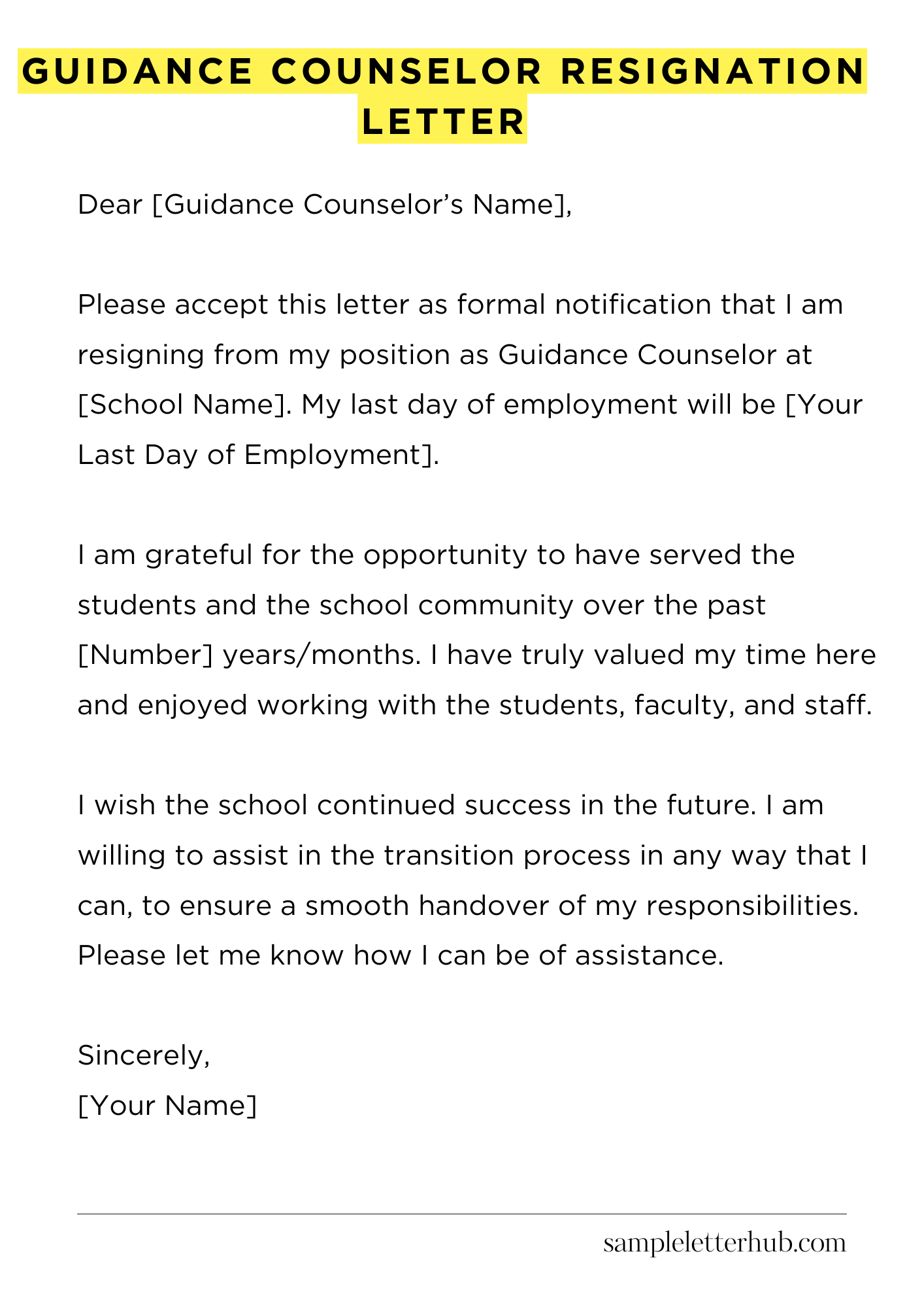
Dear [Guidance Counselor’s Name],
Please accept this letter as formal notification that I am resigning from my position as Guidance Counselor at [School Name]. My last day of employment will be [Your Last Day of Employment].
I am grateful for the opportunity to have served the students and the school community over the past [Number] years/months. I have truly valued my time here and enjoyed working with the students, faculty, and staff.
I wish the school continued success in the future. I am willing to assist in the transition process in any way that I can, to ensure a smooth handover of my responsibilities. Please let me know how I can be of assistance.
Sincerely,
[Your Name]
How to Write a Guidance Counselor Resignation Letter
So, you’re ready to move on. It’s time to craft a guidance counselor resignation letter. This isn’t just a formality. It’s a professional document that reflects your dedication and sets the stage for a smooth transition. Your letter should be clear, concise, and respectful. We’ll explore how to navigate this important process step-by-step.
1. Get Started Right: The Basic Elements
First things first, your letter needs essentials. Address it to the appropriate person, usually the principal or superintendent. Include the date. Start with a straightforward statement of your intention to resign. Specify your last day of employment. It really is that simple. This sets the foundation.
Here’s a quick format example:
[Your Name]
[Your Address]
[Your Phone Number]
[Your Email Address]

[Date]

[Recipient's Name]
[Recipient's Title]
[School Name]
[School Address]

Dear [Recipient's Name],

Please accept this letter as formal notification that I am resigning from my position as Guidance Counselor at [School Name], effective [Your Last Day of Employment].
Remember to always maintain a professional tone.
2. The Heart of the Matter: Expressing Gratitude and Providing Context
Now, let’s add some substance. Express your gratitude for the opportunity to work at the school. This is a chance to acknowledge the positive aspects of your experience. Briefly mention what you’ve enjoyed or learned. This adds a personal touch. You don’t need to write an essay. Keep it brief. If you are comfortable, you can share a general reason for leaving.
Examples of wording:
- “I am grateful for the opportunities I have been given during my time here.”
- “I have truly enjoyed my time working with the students and staff at [School Name].”
- “I am pursuing a new opportunity that aligns with my long-term career goals.”
Be positive, even if your departure is due to challenging circumstances.
3. Smooth Transitions: Offering Assistance and Cooperation
A professional resignation letter includes an offer of help. Indicate your willingness to assist in the transition. This shows your commitment to the students and the school. Offer to help train your replacement, prepare handover documents, or provide any necessary support. This is crucial.
Consider these phrases:
- “I am committed to ensuring a smooth transition and am happy to assist in any way possible.”
- “I am available to help train my replacement and prepare any handover materials.”
- “I am happy to discuss my responsibilities and provide any necessary support to ensure a seamless handover.”
This will be seen positively by those in charge.
4. Closing with Courtesy: Formalities and Contact Information
Conclude your letter with a professional closing. Use a formal salutation such as “Sincerely” or “Respectfully.” Sign your name above your typed name. Include your contact information. This is to ensure they can reach you if needed. This is an essential end to your resignation letter.
Here’s how it can look:
Sincerely,

[Your Signature]

[Your Typed Name]
Double-check everything for typos and errors.
5. Final Review and Submission: The Last Step
Before sending your letter, proofread it carefully. Ensure it is error-free. Review the tone. Is it respectful and professional? Print a hard copy and keep a copy for your records. Deliver the letter to the appropriate person. Consider hand-delivering it for a more personal touch. Make sure to adhere to any school policies. This concludes your task.
FAQs about Guidance Counselor Resignation Letter
Understanding the nuances of a guidance counselor’s resignation letter is crucial for a smooth transition and maintaining positive professional relationships. Here are some frequently asked questions about this important document:
What essential information should be included in a guidance counselor resignation letter?
A comprehensive resignation letter should include your formal resignation, the effective date of your departure, a concise statement of your reason for leaving (if you choose to provide one, though it’s not always necessary), and a sincere expression of gratitude for the opportunities you’ve been afforded.
It’s also courteous to offer assistance during the transition, such as helping to train a replacement or providing relevant information to support your students and colleagues. Finally, include your contact information for future correspondence, such as your email or phone number.
How far in advance should a guidance counselor submit their resignation letter?
Typically, it’s considered professional to submit your resignation letter at least two weeks before your intended last day of employment. However, longer notice periods might be expected depending on the school district’s policies or your employment contract.
Giving more notice allows ample time for the school to find a replacement and ensures a smoother transition for students, parents, and colleagues. Consult your employment contract or school district’s policy for specific requirements.
Can a guidance counselor’s resignation letter be used as a reference?
While a resignation letter itself isn’t typically used as a primary reference, it can serve as a documented record of your employment and departure date. It might be included in your personnel file, and a future employer might request it as part of a background check.
The letter, along with your performance evaluations and other documentation, can help paint a picture of your employment history. To get a more detailed reference, potential employers usually contact your former supervisor or someone else who can speak to your work directly.
What tone and style should be used in a guidance counselor’s resignation letter?
Maintain a professional and respectful tone throughout your letter. Use clear, concise language and avoid overly emotional or negative comments.
Expressing gratitude for the opportunities you’ve been given and acknowledging the relationships you’ve built is always appropriate. Focus on the positive aspects of your experience and keep the tone courteous, even if you are leaving due to dissatisfaction.
What if a guidance counselor is leaving mid-year?
Leaving mid-year requires careful consideration. While you have the right to resign at any time, doing so in the middle of the school year can pose challenges for the school, students, and your colleagues. If possible, consider the impact on students, and be prepared to offer assistance during the transition.
Make your resignation as early as possible so the school can manage the loss of staff. You might also want to consult with your supervisor and human resources to discuss the best approach for the specific situation, and seek professional advice when needed.
Related:
Resignation letter due to rude boss
Resignation letter moving to another state
Resignation letter due to illness of family member
Resignation letter due to study