

A chemist resignation letter is a formal document. It is written to inform an employer that a chemist is leaving their job. This letter officially marks the end of employment.
Are you a chemist planning your exit? Crafting the perfect resignation letter can feel tricky. This article is your guide. We have compiled a collection of templates. You can use these examples for inspiration.
Our goal is to simplify this process. We offer a variety of letter samples. These are designed to help you. Find the right words. Make your transition smoother.
Chemist Resignation Letter
Below is a sample of a Chemist Resignation Letter:
[Your Name]
[Your Address]
[Your Phone Number]
[Your Email Address]
[Date]
[Employer’s Name]
[Company Name]
[Company Address]
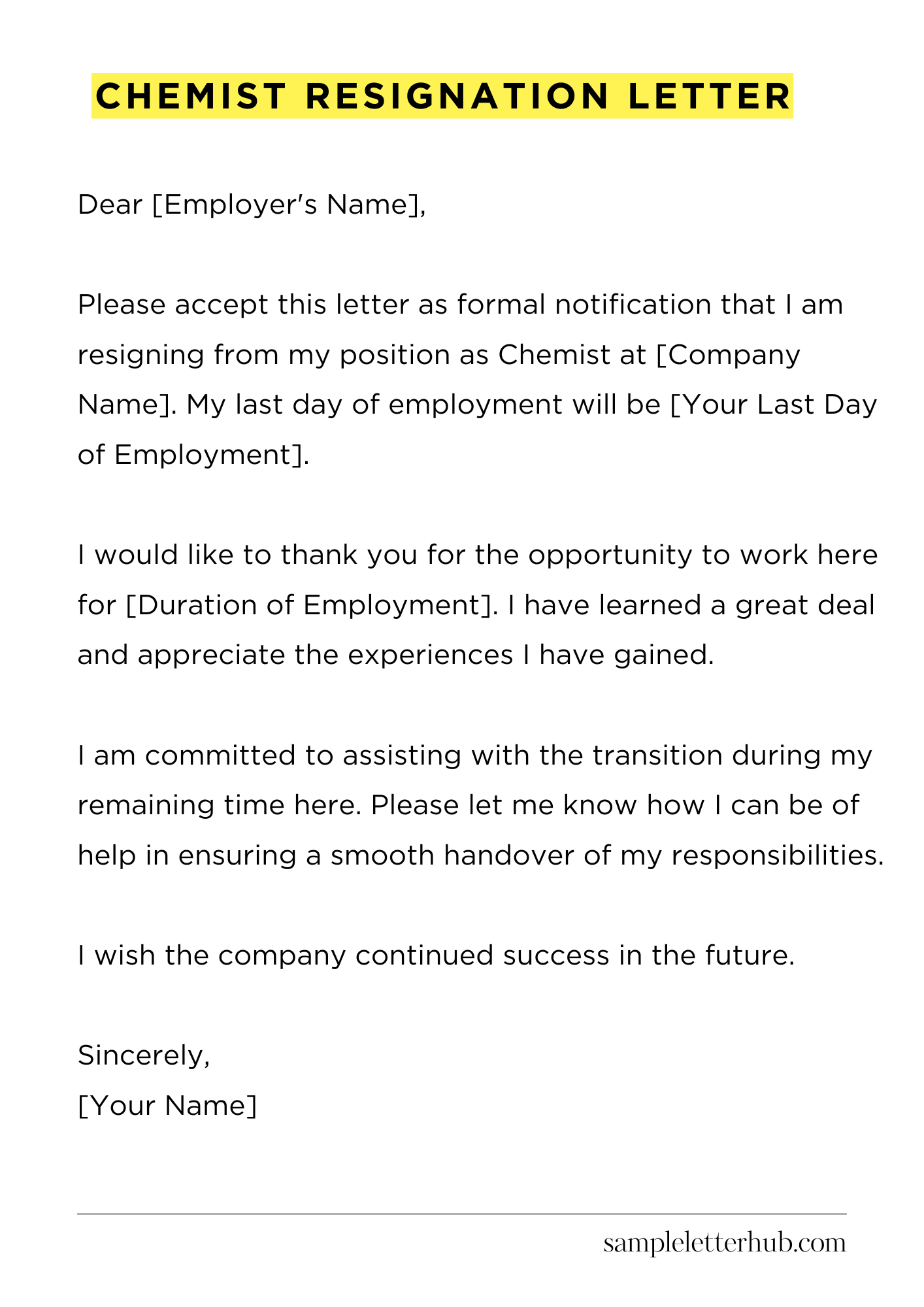
Dear [Employer’s Name],
Please accept this letter as formal notification that I am resigning from my position as Chemist at [Company Name]. My last day of employment will be [Your Last Day of Employment].
I would like to thank you for the opportunity to work here for [Duration of Employment]. I have learned a great deal and appreciate the experiences I have gained.
I am committed to assisting with the transition during my remaining time here. Please let me know how I can be of help in ensuring a smooth handover of my responsibilities.
I wish the company continued success in the future.
Sincerely,
[Your Name]
How to Write a Chemist Resignation Letter
So, you’re ready to move on. Maybe a better opportunity has presented itself, or perhaps you’re simply seeking a change. Whatever the reason, you’re now facing the task of composing a resignation letter. This is an important step; make sure it’s done right.
Step 1: Get the Basics Right
First things first: Keep it professional. Your letter should be businesslike and polite, even if your feelings about your current role are less than enthusiastic. Start with your name, address, and the date.
Then, address your letter to the appropriate person, usually your direct supervisor or the Human Resources department. Use a formal tone throughout.
Begin the body of your letter with a clear and concise statement of your intention to resign. State your position and the effective date of your resignation. For example: “Please accept this letter as formal notification that I am resigning from my position as Chemist, effective [Date].”
Step 2: Express Gratitude and Briefly Explain (Optional)
Next, it’s a good practice to express your gratitude for the opportunity to work at the company. This shows you’re a professional and leaves a positive impression, regardless of your reasons for leaving.
Consider saying something like: “I am grateful for the opportunities I have been given during my time at [Company Name].”
You may optionally provide a brief and general reason for your departure. Keep it simple. You don’t need to go into excessive detail. You could say: “I am pursuing a new opportunity that aligns with my long-term career goals.” Or, if you prefer, you can omit the reason altogether. Remember to stay positive.
Step 3: Offer Assistance with the Transition
Your goal is to depart on good terms. To achieve this, offer your assistance during the transition. Indicate your willingness to help train your replacement, complete outstanding projects, or provide any necessary documentation.
For instance: “I am committed to ensuring a smooth transition and am happy to assist in training my replacement or completing any pending projects before my departure.” This shows respect for your colleagues and your employer. This is important to ensure everything is settled before you leave.
Step 4: Keep it Concise and Avoid Negativity
Keep your letter brief and to the point. A long, rambling resignation letter is often unnecessary and can potentially backfire. Focus on the essentials: your intention to resign, the effective date, and any offers of assistance.
Avoid negative comments about your job, colleagues, or the company. Now is not the time to air grievances; it’s time to maintain professionalism.
Proofread your letter carefully before sending it. Check for any typos or grammatical errors. A well-written letter reflects positively on you and leaves a lasting good impression. A simple mistake can undermine your professionalism.
Step 5: Final Touches and Sending the Letter
End your letter with a closing, such as “Sincerely,” or “Respectfully,” followed by your typed name. Sign your letter in blue or black ink if you’re submitting a hard copy. Print a copy for your records, too.
Hand-deliver your resignation letter to your supervisor or HR, or send it via email, as per your company’s policy. If sending by email, make sure your subject line is clear and professional, such as “Resignation – [Your Name].” Remember, this letter is a formal record, so handle it accordingly. Do not forget this important step.
FAQs about Chemist resignation letter
How do I write a chemist resignation letter?
A chemist resignation letter should be professional, concise, and clearly state your intention to resign. Include the date of your resignation, your last day of employment, and a brief statement of gratitude for the opportunity.
While not mandatory, you might mention the reason for leaving, but it should be kept brief and positive. Keep the tone courteous and avoid negative comments about the employer or colleagues.
What should I include in my chemist resignation letter?
Your letter should include your name, the date, the name of your supervisor or HR contact, a clear statement of resignation, your last day of employment, a brief expression of gratitude (optional), and your signature.
Consider including contact information for future correspondence. Avoid overly detailed explanations for leaving; keep it concise and professional.
How much notice should I give in my chemist resignation letter?
The standard notice period is typically two weeks, though this can vary depending on your employment contract, company policy, or local laws. Always review your employment agreement to determine the required notice period. If no specific period is mentioned, two weeks is generally considered acceptable.
Providing more notice is often appreciated and can positively influence your relationship with your former employer.
Can I provide a reason for my resignation in the letter?
You can briefly state the reason for your resignation, but it’s not compulsory. If you choose to, keep the reason concise and professional. Common reasons include accepting a new position, pursuing further education, or personal reasons.
Avoid negative statements about your current employer or colleagues. If you’re comfortable, you can share more details in a separate conversation with your supervisor or HR.
What should I do after submitting my chemist resignation letter?
After submitting your letter, be prepared to discuss your departure with your supervisor and potentially HR. Cooperate with any exit procedures, such as handover tasks and returning company property.
Maintain a professional attitude during your remaining time at the company. If your company requests an exit interview, consider it an opportunity to offer constructive feedback. Ensure all outstanding work is completed or properly documented before your last day.
Related:
Resignation letter due to rude boss
Resignation letter moving to another state
Resignation letter due to illness of family member
Resignation letter due to study