

So, you’re a Field Supervisor ready to move on? A “Field Supervisor resignation letter” is your official goodbye. It’s a formal document. Its purpose is to inform your employer of your departure. It also serves as a record of your resignation.
Crafting this letter can feel tricky. Don’t worry, we’ve got you covered. We’ll provide a variety of templates. You can adapt them to your specific situation. Consider it your creative launchpad!
We will explore different formats. You’ll find examples for various scenarios. Need a short, sweet note? We have options. Looking for something more detailed? We have that, too. Use these to make your exit as smooth as possible.
Field Supervisor Resignation Letter
Below is a sample of a Field Supervisor Resignation Letter:
[Your Name]
[Your Address]
[Your Phone Number]
[Your Email Address]
[Date]
[Supervisor’s Name]
[Supervisor’s Title]
[Company Name]
[Company Address]
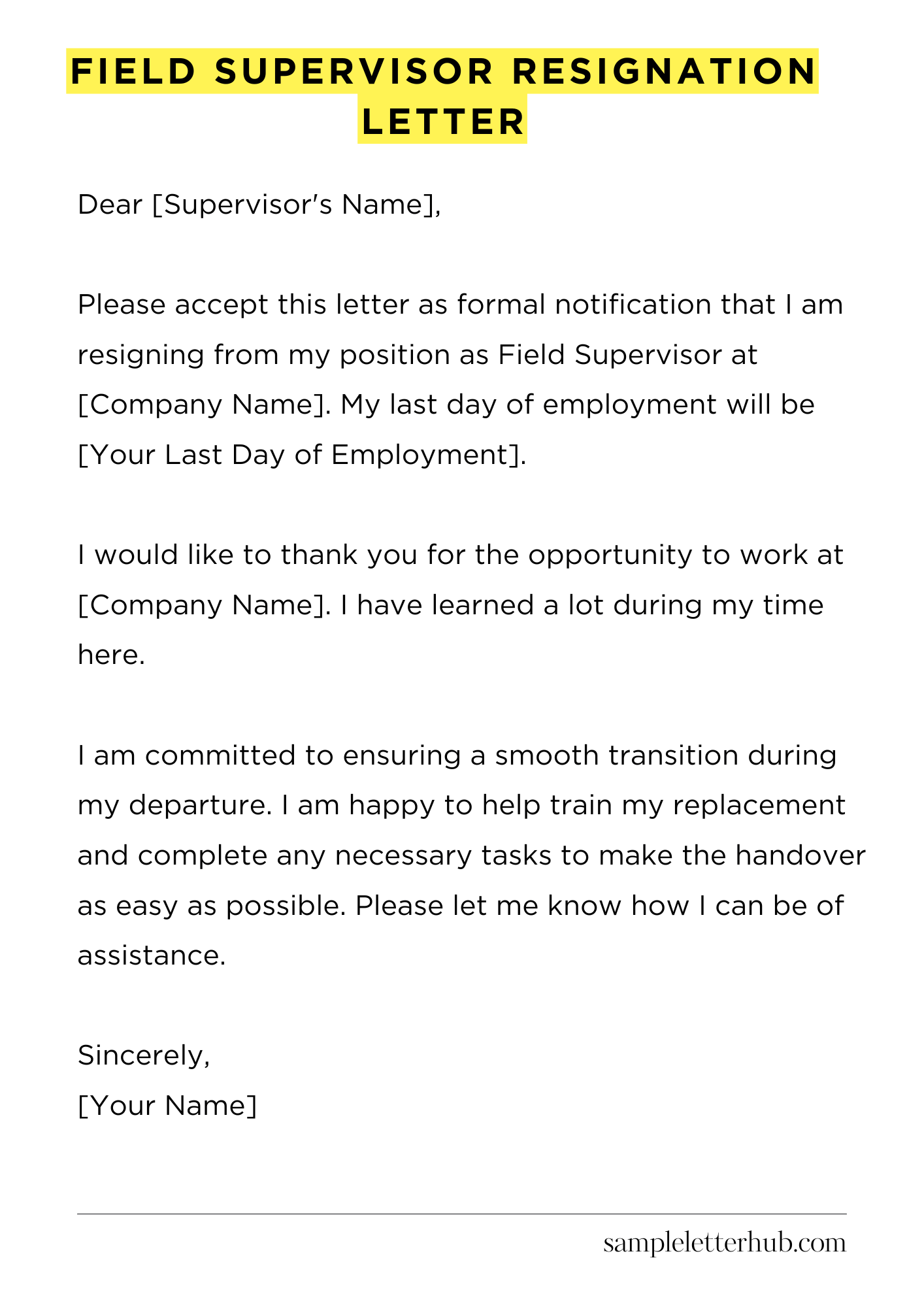
Dear [Supervisor’s Name],
Please accept this letter as formal notification that I am resigning from my position as Field Supervisor at [Company Name]. My last day of employment will be [Your Last Day of Employment].
I would like to thank you for the opportunity to work at [Company Name]. I have learned a lot during my time here.
I am committed to ensuring a smooth transition during my departure. I am happy to help train my replacement and complete any necessary tasks to make the handover as easy as possible. Please let me know how I can be of assistance.
I wish you and the company all the best in the future.
Sincerely,
[Your Name]
How to Write a Field Supervisor Resignation Letter
1. Getting Started: The Basics You Can’t Skip
Resigning from any job, especially a supervisory role, requires a professional approach. It’s important to leave a positive lasting impression. This means a well-crafted resignation letter is absolutely essential.
Don’t underestimate its importance. A poorly written letter can burn bridges, something you definitely want to avoid. Begin by formatting your letter correctly. Use a standard business letter format. This is the first impression; get it right! Include your name, address, the date, and the recipient’s name and title.
2. The Core Content: What to Actually Say
Now, let’s get into the meat of the matter. The most important part of your letter? Clearly state your intention to resign. This should be direct and unambiguous. Immediately state your intent to resign, and provide your last day of employment. Don’t beat around the bush; clarity is key here.
Next, offer a brief, polite explanation for your departure. This can be as simple as “to pursue other opportunities” or “for personal reasons.” You don’t need to overshare. This is about brevity.
3. Expressing Gratitude: Show You Appreciate It
A touch of class is always appreciated. Be sure to express your gratitude for the opportunity to have worked in the role. Thank your employer for the experience and the opportunities you’ve been given. Did you learn a lot? Did you enjoy working with a specific team? Mention it briefly.
This reinforces a positive image. A simple “Thank you for the opportunity” can go a long way. This is your chance to showcase your good character.
4. The Nitty-Gritty: Handover and Assistance
Now, to the practical matters. Offer your assistance during the transition period. Are you willing to help train your replacement? Are you available to answer any questions?
A statement along the lines of “I am committed to ensuring a smooth transition” is perfect. Be specific about what you’re willing to do. This demonstrates responsibility and a commitment to professionalism. This is how you leave on a high note.
5. Final Touches: Proofreading and Sign-Off
Nearly done! Before you hit “send,” give your letter a thorough proofread. Check for any grammatical errors or typos. Double-check the recipient’s name and title. Make sure everything is perfect.
A clean, error-free letter is a sign of respect. Finally, sign off professionally. Use a formal closing, such as “Sincerely” or “Respectfully,” followed by your typed name and your signature above it. This finishes it off with sophistication.
FAQs about Field Supervisor resignation letter
How much notice should a Field Supervisor give when resigning?
The standard notice period for a Field Supervisor resignation is typically two weeks, but this can vary. It’s best to review your employment contract or company policy to determine the specific requirements.
Some organizations may require a longer notice period, especially for senior roles or if specific projects are underway. Giving adequate notice allows for a smooth transition and ensures you leave on good terms with your employer.
What should be included in a Field Supervisor resignation letter?
A well-written resignation letter should include a clear statement of your intent to resign, the effective date of your resignation, and a brief expression of gratitude for the opportunity.
You can also mention your willingness to assist with the handover process. Avoid including negative comments about the company or your colleagues. Keep it professional, concise, and focused on the facts of your departure.
Should I provide a reason for resigning in my Field Supervisor letter?
While not mandatory, providing a brief reason for your resignation can be helpful. You can keep it general, such as “to pursue other opportunities” or “to focus on personal development.” If you have a specific reason, consider whether you want to disclose it. Focus on what you want in your next role and what opportunities you are looking for.
How should a Field Supervisor handle the handover process?
A successful handover process is crucial for a smooth transition. Offer to assist in training your replacement and provide any necessary documentation, such as project files, contact lists, and operational procedures.
Be available to answer questions and offer support during your notice period. This will demonstrate professionalism and help maintain a positive relationship with your former employer.
What if a Field Supervisor is resigning due to a difficult work environment?
If your resignation is due to a difficult work environment, consider your goals. The resignation letter itself should remain professional, even if the work environment has been challenging. You might choose to address concerns in a separate communication or during an exit interview. Focus on what you are leaving for, not what you are leaving from.
Related:
Resignation letter due to rude boss
Resignation letter moving to another state
Resignation letter due to illness of family member
Resignation letter due to study