

An Analyst Programmer resignation letter is a formal document. Its purpose is to officially inform an employer of your departure. It outlines your intention to leave your current role. It also specifies your last day of employment.
Writing a resignation letter can feel tricky. Luckily, we’ve got you covered. This article will share useful templates. You’ll find a variety of examples. These samples will make the process easier.
We’ll provide different letter formats. They’ll suit various scenarios. Whether you need a simple or more detailed letter, we have options. Use them as a starting point. Then tailor them to fit your needs.
Analyst Programmer Resignation Letter
Below is a sample of a Analyst Programmer Resignation Letter:
[Your Name]
[Your Address]
[Your Phone Number]
[Your Email Address]
[Date]
[Employer’s Name]
[Employer’s Title]
[Company Name]
[Company Address]
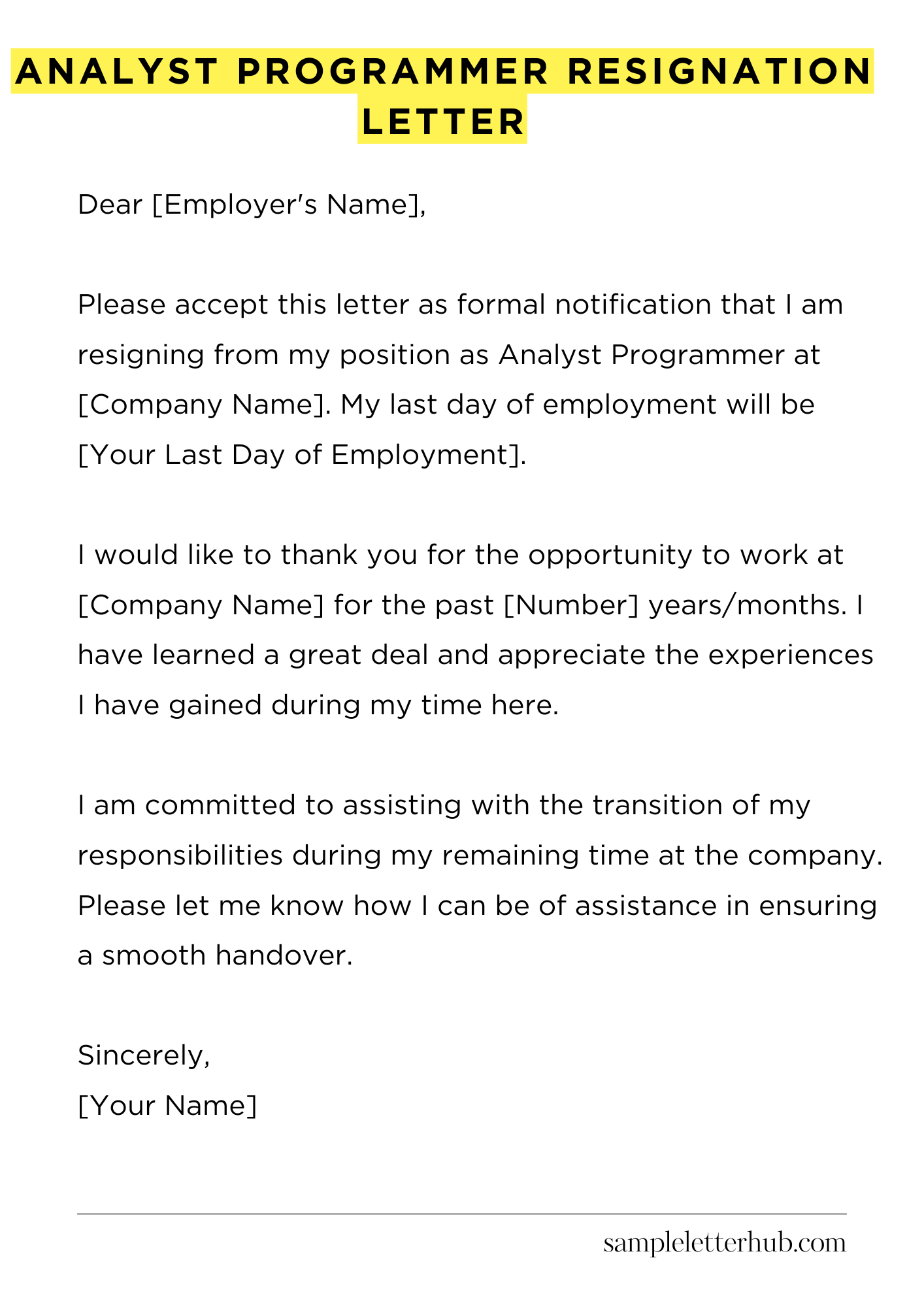
Dear [Employer’s Name],
Please accept this letter as formal notification that I am resigning from my position as Analyst Programmer at [Company Name]. My last day of employment will be [Your Last Day of Employment].
I would like to thank you for the opportunity to work at [Company Name] for the past [Number] years/months. I have learned a great deal and appreciate the experiences I have gained during my time here.
I am committed to assisting with the transition of my responsibilities during my remaining time at the company. Please let me know how I can be of assistance in ensuring a smooth handover.
I wish you and [Company Name] all the best in the future.
Sincerely,
[Your Name]
How to Write an Analyst Programmer Resignation Letter
So, you’re moving on from your role as an Analyst Programmer? That’s exciting! Whether you’ve landed a new job, are pursuing further education, or just need a change of pace, it’s essential to resign professionally.
Your resignation letter is more than just a formality; it’s a critical document that can affect your future career prospects. Writing a solid resignation letter is not as hard as it might seem. Here’s a breakdown to help you craft a professional and effective letter.
1. Start With the Basics: Your Information and the Date
First things first. You should keep it clean and simple. Begin with your full name, address, phone number, and email address. You can include your company’s information or simply skip this, but always include the date. This makes it easy for your employer to identify who is resigning and when.
Always put the date the letter is being written. Use a formal, business-like format. Avoid abbreviations, keep it clear, and easy to read. This simple start sets the stage for a professional and considerate letter.
2. Clearly State Your Intent to Resign
This is the most important part! State explicitly that you are resigning from your position. Keep the language direct and unambiguous. Something like: “Please accept this letter as formal notification that I am resigning from my position as Analyst Programmer at [Company Name].”
Avoid any vagueness or room for misinterpretation. Next, state your last day of employment. Your contract will specify this, but you can always refer to it. This gives the company the necessary time to prepare for your departure and initiate the transition process.
3. Express Gratitude and Offer Assistance
Thank the company for the opportunity. This is a crucial step! Expressing your gratitude helps maintain a positive relationship. Mention any specific skills you learned or projects you were involved in. It is polite and shows appreciation for your time there.
Offer your assistance during the transition period. Let them know you’re available to help train your replacement, complete any ongoing projects, or provide documentation.
This demonstrates professionalism and a commitment to ensuring a smooth handover. Something like: “I am happy to assist in the transition process in any way possible.” This is a key gesture!
4. Keep it Concise and Professional
Keep your letter focused. Avoid dwelling on negative aspects of your employment or venting about your reasons for leaving. Your resignation letter is not the place for that. Save it for the exit interview, which is the time and place for this.
Proofread your letter carefully. Check for any grammatical errors or typos. Double-check the company name and any other details. Errors can reflect poorly on your attention to detail. A well-written letter reflects positively on you and leaves a lasting impression.
5. Formal Closing and Your Signature
End your letter with a formal closing, such as “Sincerely,” or “Respectfully,” followed by your typed name. Then, leave space for your signature above your typed name. Always physically sign the letter, ideally in blue or black ink.
Consider sending a digital copy to your manager and the HR department. Be sure to keep a copy of the letter for your records. Following these steps ensures your resignation is handled professionally and leaves a positive impression, no matter what your reason for leaving.
FAQs about Analyst Programmer resignation letter
Resigning from a position as an Analyst Programmer requires a carefully crafted letter. Here are some of the most frequently asked questions about this important document.
What is the essential information to include in an Analyst Programmer resignation letter?
An Analyst Programmer resignation letter should include:
- A clear statement of your intention to resign.
- Your official last day of employment.
- A brief expression of gratitude for the opportunity.
- A professional tone throughout.
- Your contact information.
You should also ensure to conform with company policy and any employment contracts.
How should I format my Analyst Programmer resignation letter?
The letter should be formatted professionally, typically using a business letter format. Include your contact information at the top, followed by the date, the recipient’s name and title, and the company address.
Use a formal salutation (e.g., “Dear [Manager’s Name]”), state your resignation clearly in the first paragraph, and provide your last working day. Keep the body concise and positive, and close with a professional closing (e.g., “Sincerely” or “Respectfully”) and your typed name.
What should the tone of my Analyst Programmer resignation letter be?
Maintain a professional and positive tone. Express gratitude for the opportunities you’ve been given, even if you are leaving due to negative circumstances. Avoid negative comments about the company or colleagues. This letter serves as a professional record and could be referenced by future employers.
Should I provide a reason for my Analyst Programmer resignation in the letter?
It is generally not required to provide a detailed reason for your resignation in the letter itself. A simple statement like “I am resigning to pursue other opportunities” or “I am resigning to pursue a new career path” is sufficient. If you wish to provide more detail, do so in a separate conversation with your manager. Always adhere to company policy.
Can I use a resignation letter template for my Analyst Programmer role?
Yes, you can use a template as a starting point. However, always customize it to reflect your specific situation and personalize it to demonstrate your sincerity and professionalism. Be sure to replace the bracketed information with your own details. Review your letter for accuracy before submission.
Related:
Resignation letter due to rude boss
Resignation letter moving to another state
Resignation letter due to illness of family member
Resignation letter due to study