

A Project Leader resignation letter is a formal document. It officially informs your employer of your departure. The purpose is to communicate your decision clearly. It provides a professional record of your resignation.
Thinking of moving on? Crafting the perfect resignation letter can be tricky. Don’t worry, we’ve got you covered. We’ll provide you with various templates. You’ll find different examples and samples.
These templates are designed to make it simple. Tailor them to fit your specific situation. Writing a clear and effective letter will be a breeze.
Project Leader Resignation Letter
Below is a sample of a Project Leader Resignation Letter:
[Your Name]
[Your Address]
[Your Phone Number]
[Your Email Address]
[Date]
[Recipient Name]
[Recipient Title]
[Company Name]
[Company Address]
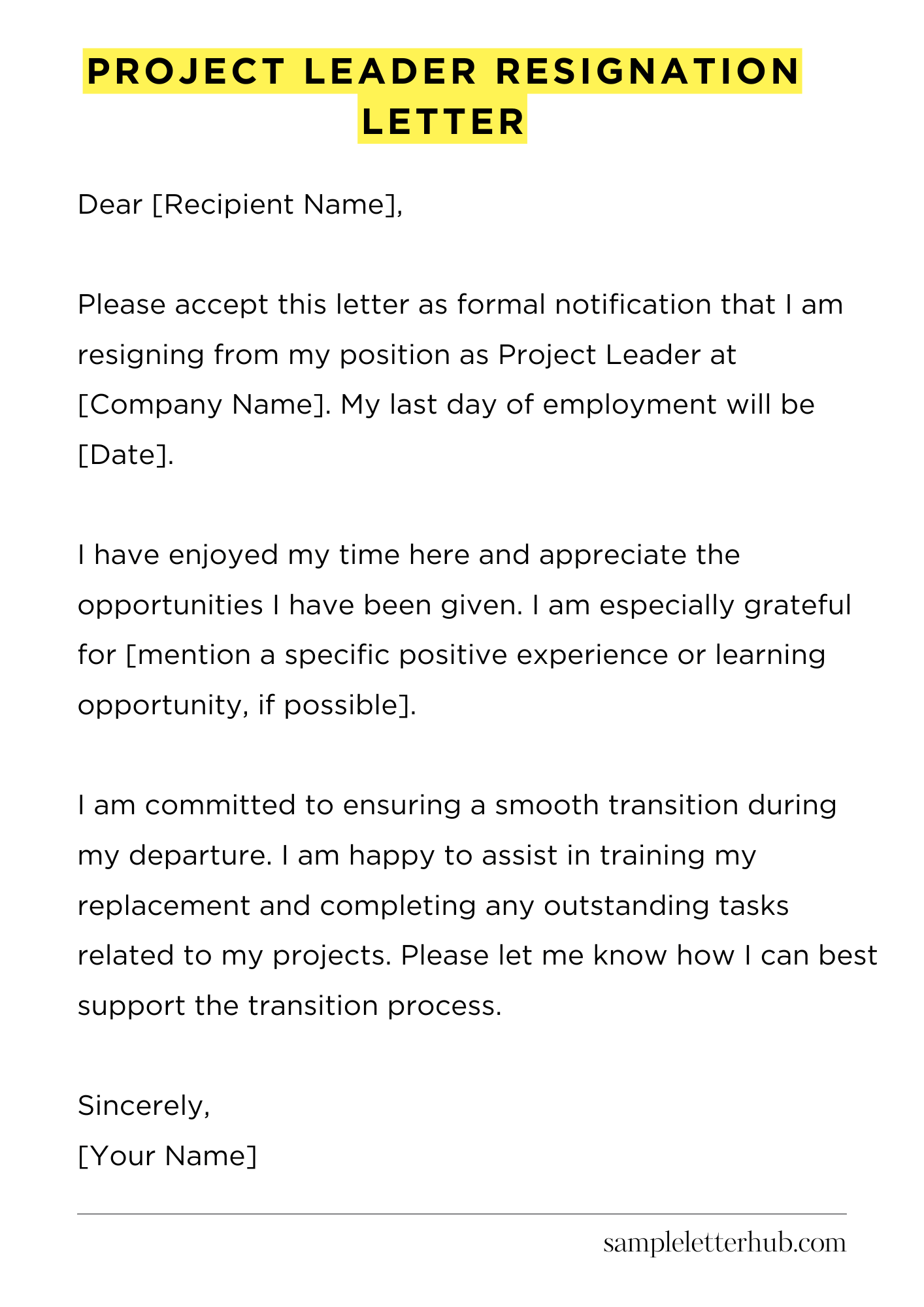
Dear [Recipient Name],
Please accept this letter as formal notification that I am resigning from my position as Project Leader at [Company Name]. My last day of employment will be [Date].
I have enjoyed my time here and appreciate the opportunities I have been given. I am especially grateful for [mention a specific positive experience or learning opportunity, if possible].
I am committed to ensuring a smooth transition during my departure. I am happy to assist in training my replacement and completing any outstanding tasks related to my projects. Please let me know how I can best support the transition process.
I wish you and [Company Name] all the best in the future.
Sincerely,
[Your Name]
How to Write a Project Leader Resignation Letter
1. Why Resign and Why Write a Letter?
So, you’re moving on. That’s a big step! Maybe you’ve got a better opportunity, or perhaps it’s simply time for a change. Whatever the reason, resigning from your role as a Project Leader requires a formal declaration. Why is a resignation letter so crucial? Think of it as your official exit announcement.
It’s a professional courtesy, a documented record of your departure, and it gives your employer a clear understanding of your plans. This letter protects your interests too, as it leaves no room for misunderstandings or ambiguity regarding your last day.
Essentially, it’s about leaving on good terms and preserving your professional reputation. That’s always a smart move.
2. Essential Elements of Your Resignation Letter
A good resignation letter is concise, clear, and professional. It’s not the place to vent or air grievances, even if you have them. Focus on the facts.
Start with a clear and direct statement of your intent to resign, including your name, the date, and your position. Next, state the effective date of your resignation – this is the day your employment officially ends.
Provide a specific date to avoid any confusion. Then, express your gratitude for the opportunity to have served in your position. A brief and sincere thank you can go a long way.
Finally, keep it brief: focus on the essentials and avoid unnecessary details.
3. Crafting the Perfect Wording
The language you use matters. Here’s an example of effective phrasing. Start with a straightforward statement like, “Please accept this letter as formal notification that I am resigning from my position as Project Leader, effective [Date].” Next, consider including a sentence of gratitude.
For example, “I am grateful for the opportunities I have been given during my time here.” You can offer assistance with the transition. A sentence like, “I am committed to ensuring a smooth handover of my responsibilities and am happy to assist in training my replacement” is useful.
End with a professional sign-off such as “Sincerely” or “Respectfully,” followed by your full name and signature (if you’re printing the letter). Make sure you proofread it!
4. Tailoring Your Letter: Adaptations and Considerations
While the core elements remain the same, you can tailor your letter to fit the specific situation. For instance, if you’re leaving for another job, you can briefly mention your future plans, but avoid going into great detail. If there are any ongoing projects you’re involved in, briefly offer to help with the transition.
Maybe you have specific concerns regarding the current ongoing projects; it is up to your discretion whether to mention them or not, depending on your relationship with the management and how you wish to end it. If you were really unhappy, keeping the tone neutral is always best.
Also, make sure you know who the letter needs to be addressed to – your direct manager, HR, or both? This is critical.
5. Delivery and Follow-Up: The Final Steps
Once you’ve written and proofread your letter, how do you deliver it? Always submit your letter in writing. Depending on your company’s policy, this could be a physical copy or an electronic version.
Consider delivering a physical copy to your supervisor directly, and, if applicable, sending a digital copy via email to your manager and HR, so there is record in both ways.
After submitting the letter, be prepared to discuss your resignation with your supervisor. Be professional and answer any questions. It is also good to cooperate in any transition efforts to help hand over your duties.
Finally, remember to keep a copy of your letter for your records. Now it is done! Good luck in the future!
FAQs about Project Leader resignation letter
How much notice should a Project Leader give when resigning?
The standard notice period for a Project Leader typically aligns with the employment contract or company policy. This period can range from two weeks to a month, or occasionally longer depending on the seniority of the role and the company’s requirements. Reviewing the employment contract is the best way to determine the stipulated notice period.
What key elements should be included in a Project Leader resignation letter?
A well-crafted resignation letter should include: a clear statement of resignation, the effective date of resignation, a brief expression of gratitude for the opportunity (optional), a concise explanation for leaving (optional, but helpful if you wish to provide it), and an offer to assist with the transition of your responsibilities.
It is also good practice to include your contact information for any outstanding matters.
Should a Project Leader explain the reasons for resigning in the letter?
While not mandatory, providing a brief, professional reason for resigning can be beneficial. It helps the employer understand your decision and may provide valuable feedback.
Keep the reason concise and positive, focusing on the future and new opportunities, or if you had a problem, in a way that is not destructive for the company. Avoid negativity or a lengthy critique of your current role.
How should a Project Leader handle the handover process after submitting the resignation letter?
The handover process is crucial for a smooth transition. Project Leaders should create a comprehensive handover document detailing project status, outstanding tasks, key contacts, and any relevant documentation.
They should also actively participate in meetings to brief their replacement or team members. Being available during the notice period to answer questions and offer support is essential.
Can a Project Leader negotiate the terms of their resignation, such as the effective date?
Yes, it’s possible for a Project Leader to negotiate the terms of their resignation. This negotiation usually involves discussing the effective date, especially if they have personal or job-related needs.
It’s important to communicate any specific requests clearly and professionally to your manager or HR. The company might be willing to compromise, particularly if they value the Project Leader’s contributions.
Related:
Resignation letter due to rude boss
Resignation letter moving to another state
Resignation letter due to illness of family member
Resignation letter due to study