

A “Manufacturing Director resignation letter” is a formal document. It is written by a Manufacturing Director. The purpose is to officially announce their departure from a company. It informs the employer of their last day of employment.
Are you a Manufacturing Director planning to move on? Writing a resignation letter can be tricky. Don’t worry, we’ve got you covered. We’ll provide helpful templates. You can customize them for your situation.
These examples are designed to make it easy. We want to help you craft a professional letter. Get ready to find the perfect words. Let’s make this process simple and stress-free.
Manufacturing Director Resignation Letter
Below is a sample of a Manufacturing Director Resignation Letter:
[Your Name/Address]
[Your Phone Number]
[Your Email Address]
[Date]
[Manufacturing Director’s Name/HR Department]
[Company Name]
[Company Address]
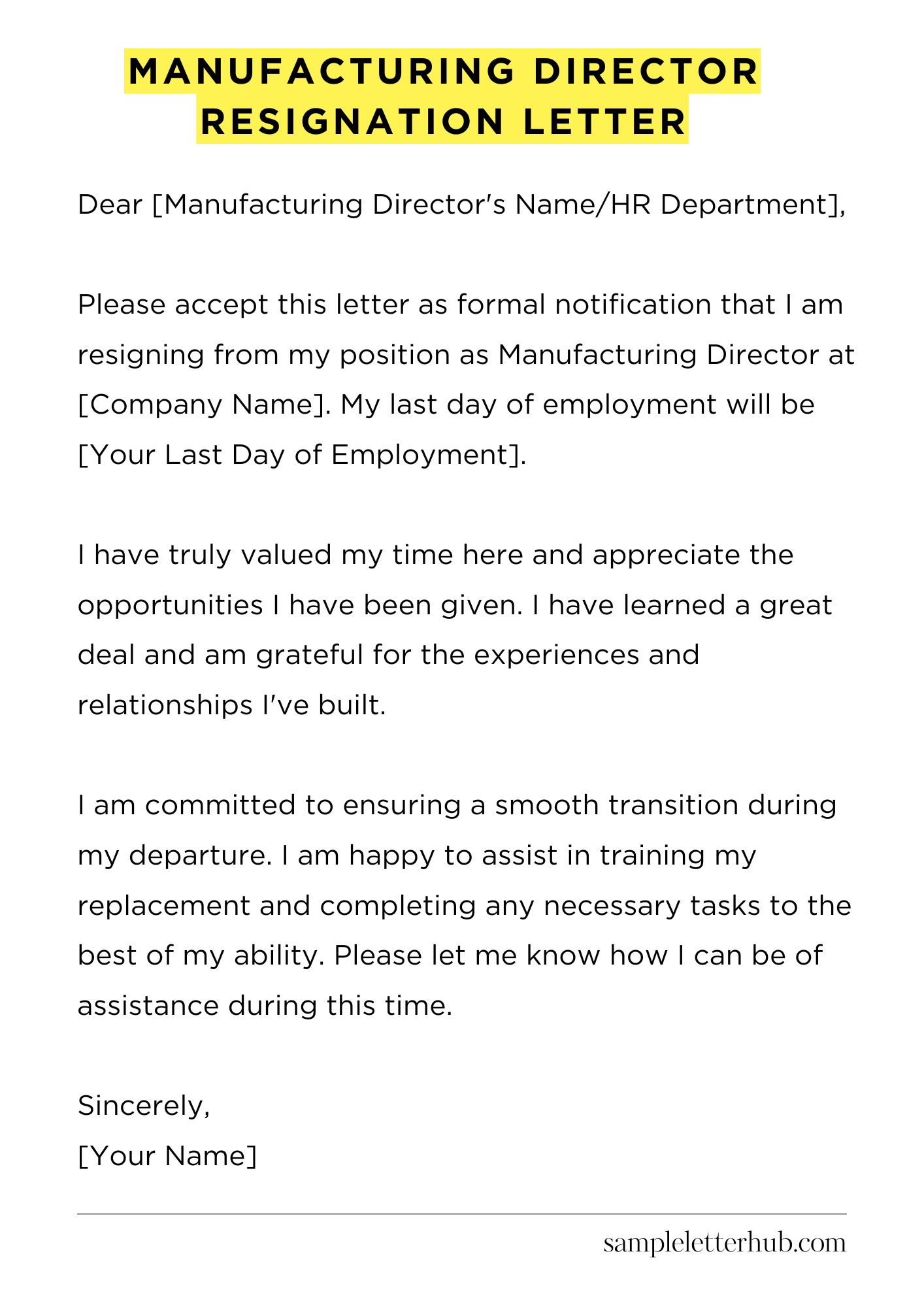
Dear [Manufacturing Director’s Name/HR Department],
Please accept this letter as formal notification that I am resigning from my position as Manufacturing Director at [Company Name]. My last day of employment will be [Your Last Day of Employment].
I have truly valued my time here and appreciate the opportunities I have been given. I have learned a great deal and am grateful for the experiences and relationships I’ve built.
I am committed to ensuring a smooth transition during my departure. I am happy to assist in training my replacement and completing any necessary tasks to the best of my ability. Please let me know how I can be of assistance during this time.
I wish [Company Name] continued success in the future.
Sincerely,
[Your Name]
How to Write a Manufacturing Director Resignation Letter
Resigning from any position can be tricky, but it’s especially important to handle it professionally when you’re a Manufacturing Director. Your departure affects many people and processes. Therefore, crafting the perfect resignation letter is paramount. It should be clear, concise, and leave a positive lasting impression. Here’s a breakdown to guide you.
1. Keep It Concise and Direct
Your letter doesn’t need to be a novel. The primary purpose is to inform your employer of your decision. State your intent to resign clearly and without ambiguity. Begin with a direct statement.
For instance, you might open with: “Please accept this letter as formal notification that I am resigning from my position as Manufacturing Director, effective [Your Last Day of Employment].” This immediately establishes your purpose. Make it easy to understand.
Avoid unnecessary details or long explanations for your departure in the first paragraph. Save these for later if you choose to include them. Be professional. Get straight to the point.
2. Express Gratitude and Positive Reinforcement
Even if you’re leaving due to negative circumstances, maintaining a positive tone is crucial. Express your gratitude for the opportunity to have worked at the company.
Acknowledge the experience you’ve gained and the people you’ve worked with.
Consider phrases like: “I am grateful for the opportunities I’ve had during my time here,” or “I have truly valued my time at [Company Name] and appreciate the experience I’ve gained.” This simple act helps maintain a good relationship. It can really go a long way.
Reflect on any positive experiences or achievements during your tenure, if appropriate. This reinforces your commitment during your time there.
3. Provide a Smooth Transition Plan
A good resignation letter demonstrates professionalism by outlining your willingness to facilitate a smooth transition. Offer your assistance in training your replacement or completing any pending projects.
This shows you’re not just abandoning your responsibilities. It is the perfect way to show that you are going to take your responsibilities seriously.
For example: “I am committed to ensuring a seamless transition and am happy to assist in training my replacement and completing any outstanding projects before my departure.” You might also offer to create a handover document. This detail speaks volumes about your work ethic.
4. Include Formalities and Specifics
Ensure your letter includes the essential information. Your letter should be dated, and include your name, the company’s name, and the address of the company.
Make sure to clearly state your last day of employment. This is a critical detail, and it sets the timeline. Clearly state the last day. Confirm the date with the HR department if needed.
Use a professional closing such as “Sincerely,” or “Respectfully,” followed by your full name and signature. If submitting electronically, your typed name usually suffices.
However, a digital signature can also be beneficial, depending on the company’s policies. Proper formatting creates an even better impression.
5. Review, Revise, and Proofread
Before sending your letter, review it carefully. Ensure your language is clear, professional, and free of errors. Check for grammatical mistakes and typos. This is essential for maintaining your credibility. Have a trusted colleague review it for a fresh perspective. Correct any errors.
Consider the potential impact of every sentence. Proofread again to ensure you’ve communicated your message effectively. A polished, error-free letter will leave a positive and lasting impression.
FAQs about Manufacturing Director Resignation Letter
What is the primary purpose of a Manufacturing Director resignation letter?
The primary purpose of a Manufacturing Director resignation letter is to formally notify the employer of the employee’s intent to leave their position.
It serves as an official record of the resignation, the effective date, and often includes expressions of gratitude or a brief explanation for leaving. It is a crucial document for initiating the transition process and ensuring a smooth departure.
What key elements should be included in a Manufacturing Director resignation letter?
A well-crafted resignation letter should include: a clear statement of resignation, the effective date of resignation, the Manufacturing Director’s name and title, the recipient’s name and title (typically the supervisor or HR representative), a brief and professional expression of gratitude.
What is the appropriate notice period for a Manufacturing Director’s resignation?
The appropriate notice period for a Manufacturing Director typically follows the company’s policy or employment contract.
Common notice periods range from two weeks to one month, or even longer, depending on the seniority of the role and the company’s requirements. It’s crucial to check the employment agreement or company handbook for specific guidelines and adhere to them.
How should a Manufacturing Director address the reason for their resignation in the letter?
Addressing the reason for resignation is optional but can be included. If included, it’s best to keep it concise and professional. Common reasons include accepting a new opportunity, pursuing personal goals, or retirement.
Avoid negativity or making complaints. Focus on the positive aspects of the experience or future plans. If the reason is a sensitive one, a brief and neutral statement, such as “pursuing other opportunities,” is often sufficient.
What steps should a Manufacturing Director take after submitting their resignation letter?
After submitting the resignation letter, the Manufacturing Director should: discuss the resignation with their supervisor, be prepared to assist with the transition by offering support in training a replacement or documenting key processes, fulfill all responsibilities until the last day of employment.
Related:
Resignation letter due to rude boss
Resignation letter moving to another state
Resignation letter due to illness of family member
Resignation letter due to study