

A Claims Assistant resignation letter formally announces your departure from a company. It’s a professional document. Its purpose is to inform your employer of your decision. It also outlines your last day of employment.
Are you a Claims Assistant ready to move on? Writing a resignation letter can feel tricky. Don’t worry, we’re here to help. This article provides helpful templates. We’ll offer different examples. Use these samples as your guide.
We aim to make the writing process simple. You can adapt these letters. Create your own personalized resignation. Make sure your departure goes smoothly.
Claims Assistant Resignation Letter
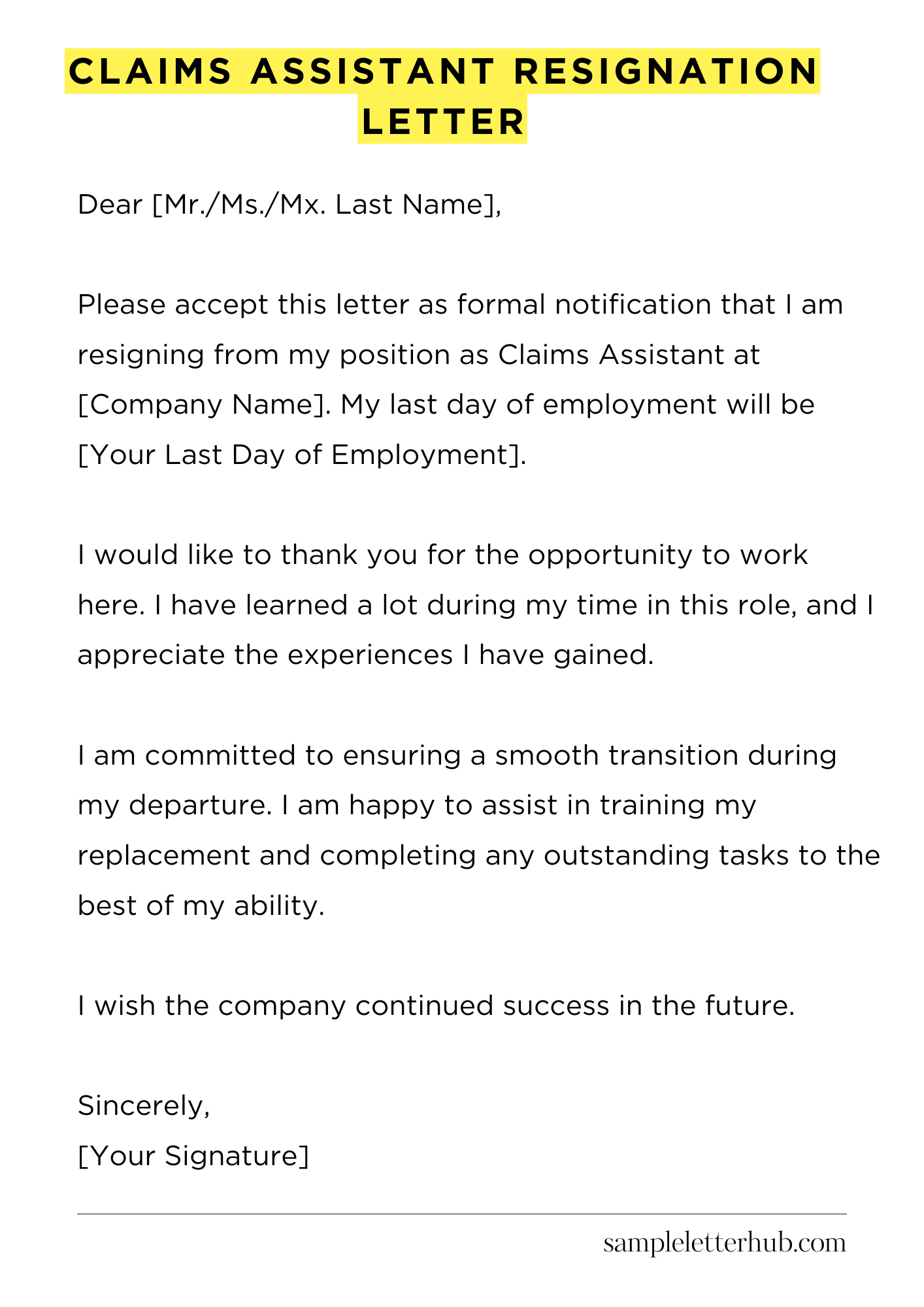
Below is a sample of a Claims Assistant Resignation Letter:
[Your Name]
[Your Address]
[Your Phone Number]
[Your Email Address]
[Date]
[Hiring Manager Name] (If known, otherwise use title)
[Hiring Manager Title]
[Company Name]
[Company Address]
Dear [Mr./Ms./Mx. Last Name],
Please accept this letter as formal notification that I am resigning from my position as Claims Assistant at [Company Name]. My last day of employment will be [Your Last Day of Employment].
I would like to thank you for the opportunity to work here. I have learned a lot during my time in this role, and I appreciate the experiences I have gained.
I am committed to ensuring a smooth transition during my departure. I am happy to assist in training my replacement and completing any outstanding tasks to the best of my ability.
I wish the company continued success in the future.
Sincerely,
[Your Signature]
How to Write a Claims Assistant Resignation Letter
Leaving a job, even one you might not particularly love, is a big step. It requires professionalism and a well-crafted letter. A Claims Assistant resignation letter is no different.
You need to do it right. This is your chance to make a graceful exit and maintain a positive professional reputation. Don’t underestimate the power of a well-written letter! This guide will help you navigate this process.
Step 1: The Basics – Format and Tone
First things first: formatting. Your letter should be business-like. Keep it clean and easy to read. Use a standard font like Arial or Times New Roman, and stick to a font size of 12.
Address the letter to your direct supervisor or the appropriate HR representative. Always maintain a professional tone. Avoid negativity, even if you’re unhappy with the job. You’re aiming for a positive and respectful approach. This shows maturity and class. The focus should be on your departure, not on complaints.
Step 2: The Core Elements – What to Include
Your resignation letter needs key information. Start with a clear statement of your intention to resign. State your position, Claims Assistant, and the date of your last day of employment.
This is crucial for clarity. Provide the exact date. Next, express your gratitude for the opportunity to work there. Briefly mention any positive experiences or skills you gained. This is a nice touch. It shows you’re leaving on good terms. You don’t need a lot of details. Keep it concise.
Step 3: Keep it Short and Sweet – Brevity is Key
Less is often more when it comes to a resignation letter. Avoid unnecessary details. Don’t over-explain your reasons for leaving. It is generally not required and can lead to complications.
Stick to the essential facts: your intention, the date, and your thanks. A short, impactful letter is more effective than a long, rambling one. Remember, you want to leave a good impression. This is much easier to do when you keep it simple. Your goal is to be professional, not to offer a long essay.
Step 4: Proofread and Proofread Again – Accuracy Matters
This is extremely important! Proofread your letter meticulously before sending it. Check for any grammatical errors, spelling mistakes, or typos. These errors can undermine your credibility.
Have a friend or colleague read it over as a second pair of eyes to catch anything you might have missed. Small mistakes can make a big difference in how you are perceived. Don’t rush this stage. Take your time, and make sure everything is perfect before you send it. A well-edited letter demonstrates attention to detail.
Step 5: Follow Up and Wrap Up
Once you’ve submitted your letter, be prepared for a response from your supervisor or HR. They might schedule an exit interview or have questions for you. Respond promptly and professionally.
Remember, you want to leave on the best possible terms. Be prepared to answer questions. Maintain a positive attitude during your final days. This helps to secure a good reference for you.
Your professionalism at this stage reflects positively on you and your future prospects. After the letter is submitted and the interview done, the next stage of your life awaits.
FAQs about Claims Assistant resignation letter
How do I write a resignation letter as a Claims Assistant?
Your resignation letter should be concise and professional. Start by stating your intention to resign from your position as a Claims Assistant. Include your last day of employment, and express gratitude for the opportunity.
You may briefly state your reason for leaving, if desired, but it’s not mandatory. Keep the tone positive and respectful. Avoid any negative comments about your employer or colleagues. Finally, provide your contact information, if you wish.
What should I include in a Claims Assistant resignation letter?
Essential components include: a clear statement of resignation (e.g., “I am writing to resign from my position as Claims Assistant”), your last day of employment, a professional and respectful tone, and an expression of gratitude. You may also include a brief reason for leaving, although this is optional. Proofread the letter carefully for any errors.
What are some common reasons for leaving a Claims Assistant role that I can include in my letter?
While not required, common reasons can be: pursuing a new career opportunity, seeking a role with better work-life balance, relocating to a different area, or accepting a position with a higher salary or different responsibilities. Keep the explanation brief and avoid negative statements about your current employer.
You can say something like: “I have accepted a new position that aligns better with my career goals” or “I am pursuing an opportunity that allows me to relocate”.
How much notice should I give when resigning as a Claims Assistant?
The standard notice period is typically two weeks. However, this may vary depending on your employment contract or company policy. Review your employment agreement to determine the required notice period. Providing more notice is always appreciated and can help maintain a positive relationship with your employer.
Can I provide a reference in my Claims Assistant resignation letter?
While not common, you can offer to assist with the transition of your responsibilities or offer yourself as a contact for future inquiries, if you wish.
A statement like “I am available to assist in the transition of my duties” or “Please feel free to contact me if you have any questions during the handover period” can be included. This is optional and demonstrating a willingness to help is considered a professional gesture.
Related:
Resignation letter due to rude boss
Resignation letter moving to another state
Resignation letter due to illness of family member
Resignation letter due to study