

A Transport Manager resignation letter is a formal document. It informs an employer of your decision to leave your position. The letter officially ends your employment. It also helps in a smooth transition.
Preparing to resign can be tricky. Knowing what to say is important. Don’t worry, we’re here to assist. This article offers helpful templates. We’ve included various examples of resignation letters.
Our aim is to make your task easy. You can adapt these samples to fit your situation. This guide simplifies the process. It allows you to create a professional resignation letter.
Transport Manager Resignation Letter
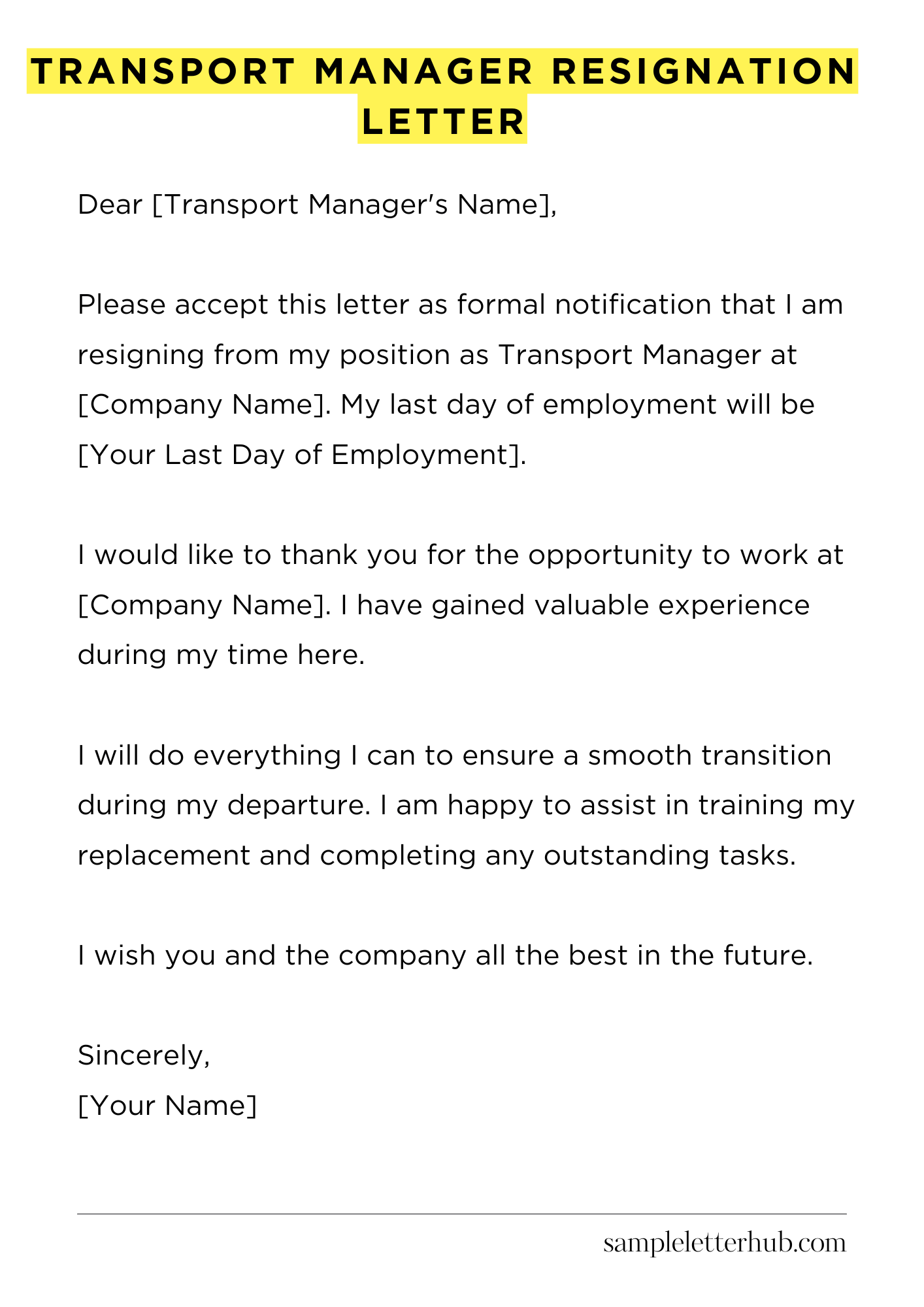
Below is a sample of a Transport Manager Resignation Letter:
[Your Name]
[Your Address]
[Your Phone Number]
[Your Email Address]
[Date]
[Transport Manager’s Name]
[Company Name]
[Company Address]
Dear [Transport Manager’s Name],
Please accept this letter as formal notification that I am resigning from my position as Transport Manager at [Company Name]. My last day of employment will be [Your Last Day of Employment].
I would like to thank you for the opportunity to work at [Company Name]. I have gained valuable experience during my time here.
I will do everything I can to ensure a smooth transition during my departure. I am happy to assist in training my replacement and completing any outstanding tasks.
I wish you and the company all the best in the future.
Sincerely,
[Your Name]
How to Write a Transport Manager Resignation Letter
So, you’re ready to move on. You’ve made a decision, and it’s time to resign from your role as a Transport Manager. That’s a big step! But before you walk out the door, you need to craft a professional resignation letter. This is more than just a formality; it’s a crucial document. Here’s a simple guide to help you do it right.
1. Get Started: The Essentials
Your resignation letter needs to be clear, concise, and professional. It’s a formal communication. Think about it this way: this is your lasting impression, in written form.
First things first: include your name, address, phone number, and email address at the top. This is standard practice. Below that, add the date. Then, address your letter to the correct person. This is usually your direct supervisor, or the HR Manager. Keep it formal: use their title and last name. For example: “Dear Mr. Smith,”
2. State Your Intent: The Core Message
The main purpose of your letter is to clearly and unequivocally state your resignation. Be direct! Begin with a simple and direct sentence that states your intention to resign.
Include your job title and the date your resignation will be effective. For example: “Please accept this letter as formal notification that I am resigning from my position as Transport Manager, effective [Date].” This is critical information that has to be present.
3. Express Gratitude: The Polite Touch
Even if things didn’t always go smoothly, it’s always a good idea to express gratitude for the opportunity. This shows professionalism and respect.
A short sentence acknowledging your experience or thanking the company for the opportunity is a nice touch. For instance, “I am grateful for the experience and opportunities I’ve gained during my time at [Company Name].” It is a good practice.
4. Offer Assistance: The Bridge-Building Option
This is where you go above and beyond. Offering assistance with the transition can make a positive impact. Consider offering to help train your replacement, complete any outstanding tasks, or provide any necessary documentation. This demonstrates your commitment to a smooth handover.
You might write: “I am committed to ensuring a smooth transition and am happy to assist in training my replacement, or completing any outstanding tasks.” It helps everyone.
5. Closing and Next Steps: The Wrap-Up
Finally, close your letter with a professional closing, such as “Sincerely,” or “Regards,” followed by your typed name. Sign the letter by hand if you are delivering a physical copy.
Consider keeping a copy of the letter for your records. Before sending it, proofread it carefully to ensure there are no errors in grammar or spelling. Make sure it is clear and professional. You are done!
FAQs about Transport Manager resignation letter
Why is a well-crafted resignation letter important for a Transport Manager?
A well-crafted resignation letter is crucial for a Transport Manager for several reasons. Firstly, it formally initiates the separation process, ensuring a clear record of the resignation.
Secondly, it allows you to express your gratitude for the opportunity and maintain a professional relationship with the employer. Finally, a well-written letter can help you leave on positive terms, which is important for future references and career prospects within the industry.
What key elements should be included in a Transport Manager resignation letter?
A Transport Manager’s resignation letter should include: a clear statement of resignation, the effective date of your departure, a concise reason for leaving (if desired), expressions of gratitude for the opportunity, a willingness to assist with the transition, and your contact information.
Be sure to address the letter to the appropriate individual (e.g., your direct supervisor or HR). Consider including a brief overview of your accomplishments and contributions during your tenure.
What is the recommended notice period for a Transport Manager resignation?
The standard notice period for a Transport Manager resignation is typically outlined in your employment contract or company policy. Generally, this period is between two to four weeks, but it can vary.
It’s crucial to review your contract and company guidelines. Providing adequate notice demonstrates professionalism and allows your employer sufficient time to find a replacement and ensure a smooth handover of your responsibilities.
How should a Transport Manager handle the handover of responsibilities?
During the handover period, a Transport Manager should be proactive in transferring knowledge and responsibilities. This involves preparing detailed documentation, training the incoming manager (or designated replacement), and providing support to ensure a smooth transition. Identify key projects, ongoing issues, and crucial contacts.
Be prepared to answer questions and offer guidance to facilitate the continuity of operations. A thorough handover helps prevent disruptions and demonstrates commitment to the company.
What are some common mistakes to avoid in a Transport Manager resignation letter?
Common mistakes to avoid include: being overly negative or critical of the company or colleagues, providing excessive or unnecessary details, and failing to provide the required notice period.
Additionally, avoid making demands or including any terms that are not explicitly stated in your employment agreement. Maintain a professional tone and focus on a positive departure. Double-check for any grammatical errors or typos before submitting the letter.
Related:
Resignation letter due to rude boss
Resignation letter moving to another state
Resignation letter due to illness of family member
Resignation letter due to study