

An advertising resignation letter formally announces your departure from an advertising role. It’s a professional document. Its purpose is to notify your employer of your decision. It also outlines your final day of employment.
Crafting a resignation letter can feel daunting. Don’t worry, we are here to help. We’ll share various templates. We’ll also provide examples and samples.
Use them to create your perfect letter. We want to make the process simple. Let’s make saying goodbye easy.
Advertising Resignation Letter
Below is a sample of a Advertising Resignation Letter:
[Your Name]
[Your Address]
[Your Phone Number]
[Your Email Address]
[Date]
[Employer’s Name]
[Employer’s Title]
[Company Name]
[Company Address]
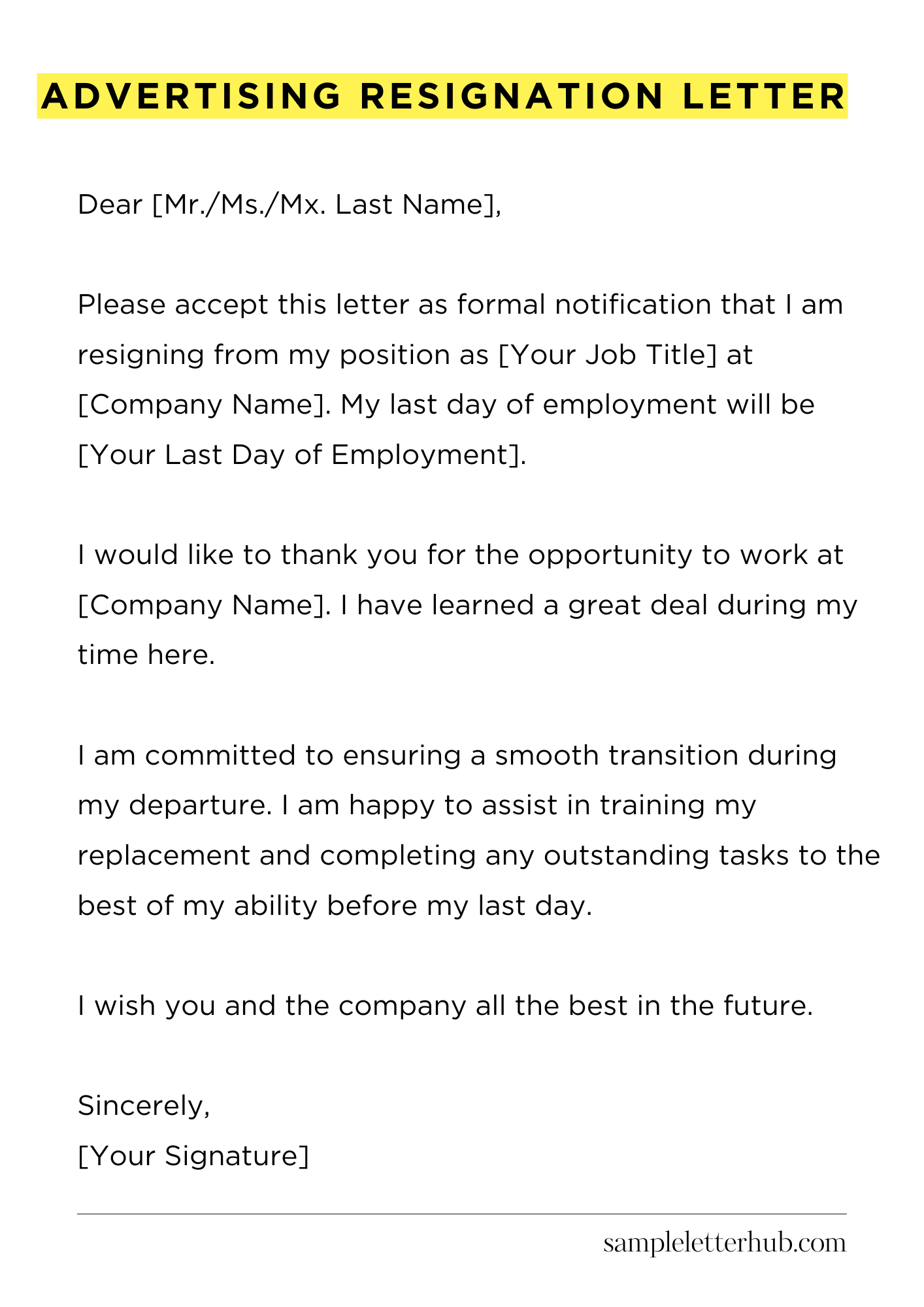
Dear [Mr./Ms./Mx. Last Name],
Please accept this letter as formal notification that I am resigning from my position as [Your Job Title] at [Company Name]. My last day of employment will be [Your Last Day of Employment].
I would like to thank you for the opportunity to work at [Company Name]. I have learned a great deal during my time here.
I am committed to ensuring a smooth transition during my departure. I am happy to assist in training my replacement and completing any outstanding tasks to the best of my ability before my last day.
I wish you and the company all the best in the future.
Sincerely,
[Your Signature]
How to Write an Advertising Resignation Letter
1. Grasping the Basics: Why Your Letter Matters
So, you’re moving on. That’s great! Whatever your reasons, your advertising resignation letter is important. It’s more than just a formality. It serves as your official notice.
It also shapes the impression you leave behind. This letter reflects your professionalism, even as you embark on a new chapter. Consider it your final piece of advertising, but this time, it’s about you.
A well-crafted letter can ensure a smooth transition. It can also help maintain positive relationships with your former employer. A poorly written one, however, might cause unnecessary problems.
Think of it as a final campaign, and you, the client. You must communicate clearly and effectively. This letter is your chance to shine. Make it count.
2. Essential Elements: What to Include
Every resignation letter needs specific components. Missing these can create confusion. First, start with the date. Then, state your intention to resign clearly and concisely.
Include the effective date of your resignation. This is the date your employment officially ends. Be specific! Next, show gratitude for the opportunity. Mentioning a specific skill or project you enjoyed demonstrates sincerity. This makes a positive impact.
Keep the tone professional. A brief explanation of your reason can be included. However, it’s not strictly necessary. It can be a simple sentence. This could prevent awkwardness.
Always express your willingness to assist with the handover process. This demonstrates responsibility and a commitment to helping.
3. Crafting the Content: Key Phrases and Tone
The right words matter. Choose them carefully. Start with a straightforward statement. For example: “Please accept this letter as formal notification that I am resigning from my position as [Your Job Title] at [Company Name], effective [Date].”
Follow that with a sentence expressing gratitude. “Thank you for the opportunities I’ve been given here.” Or “I have really enjoyed working on [Project or Skill] during my time here.”
Keep the tone professional and positive. Avoid negativity. Don’t bad-mouth your former employer. Focus on the positive aspects of your experience. Close with a sincere offer to help. “I’m happy to assist with the transition.
I will do my best to ensure a smooth handover.” Proofread! Check for errors. Double-check everything. This will prevent mistakes. This shows attention to detail.
4. Tailoring Your Letter: Adaptability is Key
No two situations are identical. Customize your letter to fit your specific circumstances. Consider the company culture. If the atmosphere is formal, be more formal in your writing. If you have a good relationship with your manager, you might include a slightly more personal touch. However, always remain professional.
If you’re leaving for a competitor, tread carefully. You don’t need to overshare sensitive information. Focus on the positive experiences. If your reasons are complex, you don’t need to go into great detail. Keep it brief. Stay focused on your primary goal: a clean and professional exit. Be thoughtful with every word.
5. Proofreading and Delivery: Final Steps to Success
This is the final check! Proofread your letter meticulously. Check for grammar and spelling errors. Errors can undermine your message. Review the formatting. Ensure it looks professional. Have a trusted friend or colleague review it too. A fresh pair of eyes can often catch mistakes you missed.
The method of delivery matters. Understand your company’s protocol. Usually, you’ll hand it to your manager. Sometimes, you may need to send it to HR. In this digital age, email is common.
However, always keep a hard copy for your records. Consider the timing. Giving your notice in person, then following up with the letter, is often the most polite approach. You are now prepared to move forward. Good luck!
FAQs about Advertising Resignation Letters
Why is it important to write a resignation letter in the advertising industry?
A well-crafted resignation letter is crucial in the advertising industry for several reasons. It formally notifies your employer of your departure, serves as a record of your resignation, and helps maintain a professional reputation.
Leaving on good terms is vital in this close-knit industry, as your network and past performance often precede you. Moreover, a clear letter can help ensure a smooth transition, potentially protecting your references and future opportunities.
What should be included in an advertising resignation letter?
An effective advertising resignation letter should include: a clear statement of your intent to resign, the date of your last day of employment (in accordance with your employment contract and company policy), a brief and professional expression of gratitude for the opportunity, and acknowledgment of any handover plans.
It’s often beneficial to offer assistance in the transition process. Avoid negative comments about your employer or colleagues.
How much notice should I give when resigning from an advertising agency?
The standard notice period in the advertising industry typically ranges from two to four weeks. This is usually specified in your employment contract. It’s crucial to review your contract to ensure you comply with the agreed-upon notice period.
Giving sufficient notice demonstrates professionalism and allows your employer ample time to find a replacement and facilitate a smooth transition of your responsibilities. Consider the complexity of your role and ongoing projects when determining your notice period; consult with your employer if in doubt.
Can I use a template for my advertising resignation letter?
Yes, using a template is perfectly acceptable and can be a good starting point. However, it’s essential to personalize it to reflect your specific situation and the nature of your role within the advertising agency.
Ensure the language is appropriate and the tone is professional. Tailor the content to include any specific contributions, your reasons for leaving (if you choose to include them), and your willingness to help with the transition. Avoid generic phrases and proofread it carefully.
How should I deliver my resignation letter in the advertising world?
Typically, a resignation letter should be delivered in writing, preferably via email and a hard copy to your direct supervisor or the relevant HR representative. Always adhere to the company’s established procedures, which may be outlined in your employee handbook. Always keep a copy for your records.
Before submitting the letter, it’s customary to inform your supervisor of your decision in person (if circumstances allow) or via a phone call prior to the formal letter submission.
Related:
Resignation letter due to rude boss
Resignation letter moving to another state
Resignation letter due to illness of family member
Resignation letter due to study