

A Food Service Manager resignation letter is a formal document. It officially announces your departure from a food service management position. The letter’s purpose is to inform your employer of your intention to leave. It also provides a date for your last day of employment.
Writing a resignation letter can be tricky. You want to be professional and clear. Finding the right words can be tough. We’ve got you covered.
This article shares various templates. We provide examples and samples. Use them to create your own perfect resignation letter. Make your departure smooth and respectful.
Food Service Manager Resignation Letter
Below is a sample of a Food Service Manager Resignation Letter:
[Your Name]
[Your Address]
[Your Phone Number]
[Your Email Address]
[Date]
[Manager’s Name]
[Manager’s Title]
[Restaurant Name]
[Restaurant Address]
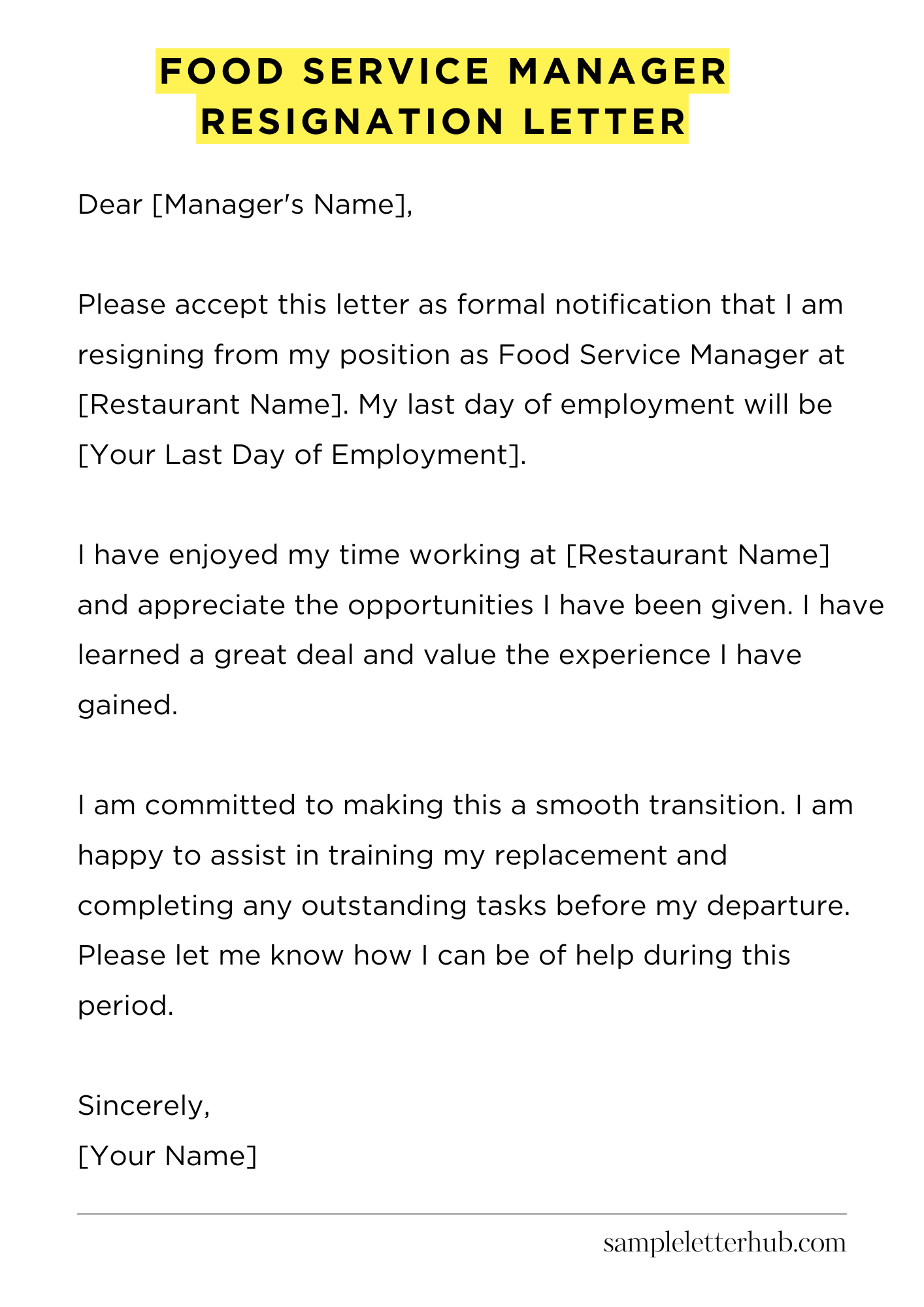
Dear [Manager’s Name],
Please accept this letter as formal notification that I am resigning from my position as Food Service Manager at [Restaurant Name]. My last day of employment will be [Your Last Day of Employment].
I have enjoyed my time working at [Restaurant Name] and appreciate the opportunities I have been given. I have learned a great deal and value the experience I have gained.
I am committed to making this a smooth transition. I am happy to assist in training my replacement and completing any outstanding tasks before my departure. Please let me know how I can be of help during this period.
I wish you and [Restaurant Name] continued success in the future.
Sincerely,
[Your Name]
How to Write a Food Service Manager Resignation Letter
1. The Core Components: What You Absolutely Need
So, you’ve made the decision. You’re moving on from your Food Service Manager role. Excellent! Now it’s time to craft a resignation letter. This is a critical professional document.
First things first: always be polite. This might seem obvious, but it’s important. Start with your name, address, phone number, and email. Then, add the date, followed by your manager’s name, their title, and the restaurant’s address. Keep it brief. Get straight to the point. It is not a place for lengthy explanations.
Remember this is a formal declaration. Keep it professional. State clearly that you are resigning, including your last day of employment. This is non-negotiable.
2. Expressing Gratitude: A Touch of Class
You may be leaving, but you can still be gracious. Express your gratitude for the opportunity. You can mention specific aspects of your experience you appreciated.
A line about learning valuable skills or enjoying your time at the restaurant can go a long way. Think about the positive aspects of your tenure.
Did you enjoy working with a specific team? Mention it. Did you appreciate a mentor or a particular program? Include it. A simple “Thank you for the opportunity” can make a significant impact.
It maintains a positive tone and leaves a good impression. This helps preserve your professional reputation.
3. Providing a Smooth Transition: Making it Easy
Your responsibilities don’t end the moment you decide to leave. You still have a job to do. To make it smooth for everyone, offer assistance with the transition. Offer to train your replacement.
You could also help with any outstanding tasks before your departure. Perhaps you can create a handover document. This shows you’re committed to ensuring a seamless handover. A well-executed transition protects your reputation. It can also open doors for future opportunities. The goal is to make things easy for your employer.
4. Keeping it Concise: Don’t Overdo It
This isn’t a novel. Your resignation letter should be concise and to the point. Avoid long, rambling paragraphs. Keep each sentence and paragraph focused. Stick to what’s important: your resignation, gratitude, and offer to help.
Resist the urge to include a laundry list of complaints. Leave any grievances for an exit interview, if one is scheduled. The goal here is to be professional, not to air out your issues. A short and direct letter is generally the most effective. Keep it clean, and keep it clear.
5. Proofreading and Finalizing: The Devil is in the Details
Before you send the letter, proofread it carefully. Check for any grammatical errors or typos. Double-check the dates and addresses. A well-written letter shows attention to detail. This is a reflection of your professionalism.
Have a friend or colleague read it over, too. Sometimes a fresh pair of eyes can catch something you missed. Finally, print it and sign it. If you’re submitting electronically, use a professional font and format. Ensure it’s easy to read. After that, it is ready to be sent to your employer.
FAQs about Food Service Manager Resignation Letter
Understanding the nuances of crafting a resignation letter as a Food Service Manager is crucial for a smooth transition. Here are some frequently asked questions and their respective answers to guide you through the process.
What essential information should I include in my Food Service Manager resignation letter?
Your resignation letter should clearly state your intention to resign, the effective date of your resignation, and your formal position. Include a brief, professional statement of gratitude for the opportunity.
While not mandatory, you might briefly mention the reason for leaving, but keep it concise and positive. Your letter should also include your contact information for any follow-up.
What is the appropriate format for a Food Service Manager resignation letter?
The standard format includes a formal business letter layout. Begin with your contact information followed by the date, and the employer’s information.
Use a professional salutation (e.g., “Dear [Manager’s Name]”), state your resignation, effective date, and a thank-you note. Close with a professional closing (e.g., “Sincerely,” or “Respectfully,”), and your typed name and signature. Keep the letter concise and professional.
How much notice should I give when resigning as a Food Service Manager?
Typically, a two-week notice is considered standard professional courtesy. However, your employment contract or company policy may stipulate a different notice period.
Always review your employment agreement to confirm the required timeframe. Providing adequate notice ensures a smoother transition and allows time for your employer to find a replacement.
Should I provide a reason for my resignation in the letter?
While you are not obligated to provide a detailed explanation, it’s often polite to offer a brief, positive reason for leaving. This can be as simple as “pursuing other opportunities” or “relocating.”
Avoid negativity or complaints. Keep the focus on your future goals rather than any dissatisfaction with the current role. A brief statement is often sufficient, if you choose to include a reason.
How should I deliver my Food Service Manager resignation letter?
The best practice is to deliver your resignation letter in person to your direct supervisor. Provide a printed copy. Follow up with an email to confirm receipt and provide a digital copy for their records.
Maintain a professional demeanor and be prepared to discuss your resignation calmly and respectfully. Ensure all company protocols for communication is followed.
Related:
Resignation letter due to rude boss
Resignation letter moving to another state
Resignation letter due to illness of family member
Resignation letter due to study