

A “Letter To Airline For Business Partnership Proposal” is a formal document. It outlines a potential business collaboration. Companies use it to pitch services or products to airlines. They aim for a mutually beneficial relationship.
Need to write such a letter? You’re in the right place. Crafting the perfect proposal can be tricky. We’ll help you make a strong first impression.
This article provides templates and examples. Use these samples to create your own letter. Secure that airline partnership you’ve been dreaming of.
Letter To Airline For Business Partnership Proposal
[Your Name/Company Name]
[Your Address]
[Your Phone Number]
[Your Email Address]
[Date]
[Airline’s Name]
[Airline’s Address]
Subject: Business Partnership Proposal
Dear [Name of Contact Person, if known, or “To Whom It May Concern”],
I hope this letter finds you well.
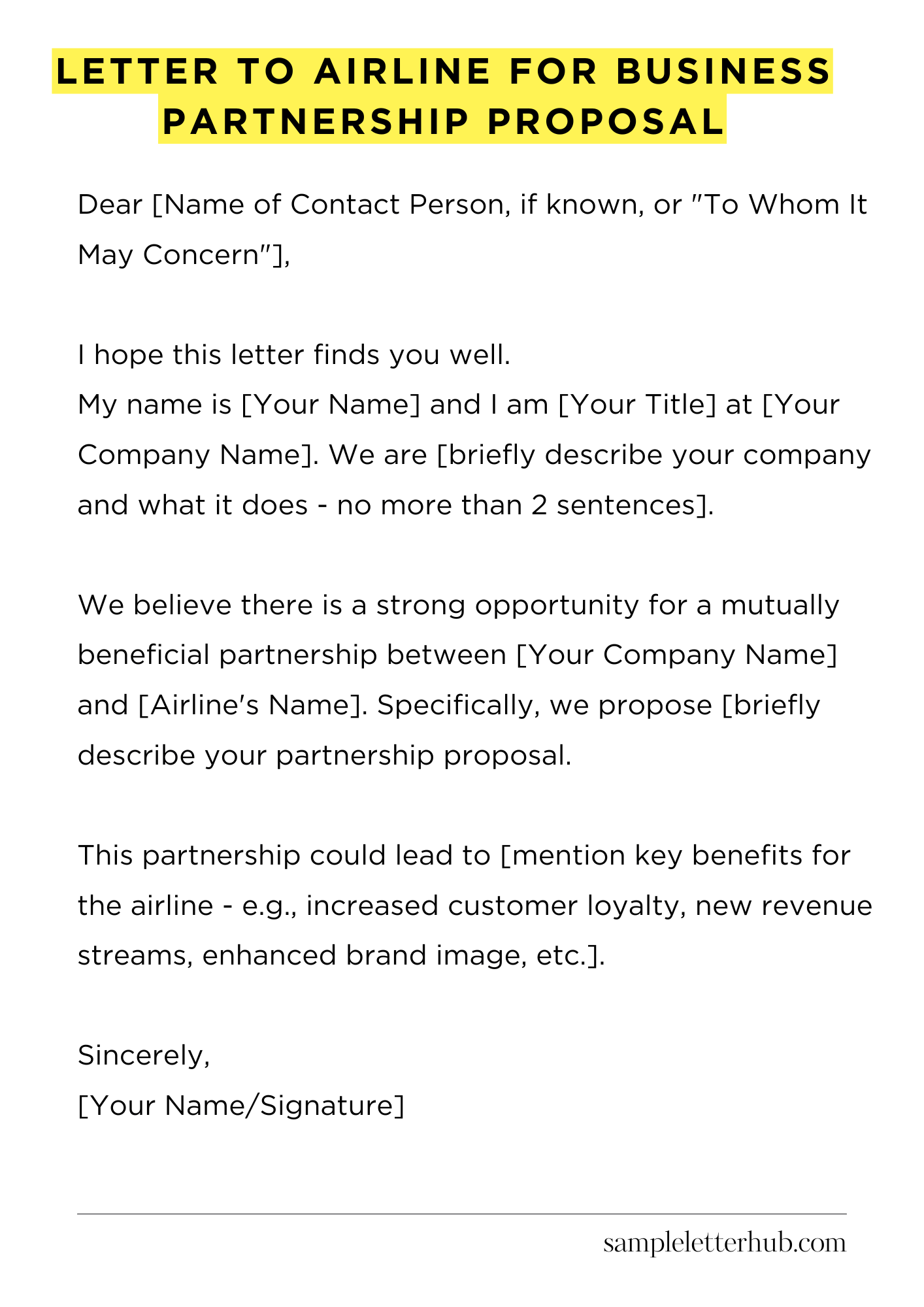
My name is [Your Name] and I am [Your Title] at [Your Company Name]. We are [briefly describe your company and what it does – no more than 2 sentences].
We believe there is a strong opportunity for a mutually beneficial partnership between [Your Company Name] and [Airline’s Name]. Specifically, we propose [briefly describe your partnership proposal – e.g., offering discounted rates to your employees, integrating your services with their booking system, etc.].
This partnership could lead to [mention key benefits for the airline – e.g., increased customer loyalty, new revenue streams, enhanced brand image, etc.]. We are confident that our proposal aligns with [Airline’s Name]’s commitment to [mention something positive about the airline, like customer satisfaction or innovation].
We have attached a detailed proposal outlining the specifics of our partnership idea. We would be delighted to schedule a meeting to discuss this further at your convenience.
Thank you for your time and consideration.
Sincerely,
[Your Name/Signature]
How to Write Letter To Airline For Business Partnership Proposal
Subject Line: Capturing Attention from the Get-Go
- Craft a subject line that is both concise and intriguing. Avoid generic phrases.
- Instead of “Business Partnership Proposal,” try something like: “Synergistic Alliance: [Your Company] & [Airline Name] – Elevating Customer Experience.”
- A well-crafted subject line piques curiosity and compels the recipient to open the email.
Salutation: Setting a Professional Tone
- Research the appropriate contact person. Addressing the letter to a specific individual demonstrates diligence.
- If a name is unavailable, opt for a formal yet approachable greeting such as “Dear Partnership Development Team,”
- Avoid overly casual salutations like “Hi” or “Hello.”
Introduction: Hooking the Reader Immediately
- Begin with a compelling opening paragraph that succinctly introduces your company and the purpose of your letter.
- Highlight your company’s mission and values, emphasizing any alignment with the airline’s ethos.
- For example: “[Your Company] is a purveyor of bespoke travel solutions, committed to enhancing passenger journeys. We believe a synergistic partnership with [Airline Name] would unlock unprecedented value for your clientele.”
Body Paragraphs: Articulating the Value Proposition
- Clearly delineate the proposed partnership’s benefits for the airline. Quantify the potential gains whenever possible.
- Detail your company’s unique selling points and how they complement the airline’s services.
- Address potential concerns or objections preemptively, showcasing your proactive approach.
- Provide concrete examples of how your collaboration can augment revenue streams, improve customer satisfaction, or streamline operations.
Supporting Evidence: Bolstering Your Claims
- Substantiate your claims with data, testimonials, and case studies.
- Include relevant metrics demonstrating your company’s past successes and capabilities.
- A concise appendix or attachment can house more detailed information without overwhelming the reader in the main body.
- Ensure all data is accurate and presented in a visually appealing manner.
Call to Action: Prompting the Next Steps
- Clearly state your desired outcome. Schedule a meeting, request a phone call, or invite them to a presentation.
- Make it easy for the recipient to respond by providing your contact information prominently.
- Suggest a specific timeframe for the next steps to create a sense of urgency.
- For instance: “We would be delighted to schedule a brief call to further elaborate on this mutually beneficial proposition. Please let us know your availability in the coming week.”
Closing: Ending on a High Note
- Conclude with a professional and courteous closing.
- “Sincerely,” or “Respectfully,” are appropriate choices.
- Reiterate your enthusiasm for the potential partnership and express gratitude for their time and consideration.
- Ensure your signature includes your full name, title, and contact information.
Frequently Asked Questions: Airline Business Partnership Proposals
This section addresses common inquiries regarding crafting and submitting a business partnership proposal to an airline. Understanding these points can significantly enhance the effectiveness of your proposal.
What information should I include in my proposal?
Your proposal should include a clear description of your company, the proposed partnership, its benefits to the airline, financial projections, and relevant experience or qualifications.
Who should I address the letter to?
Address the letter to the appropriate decision-maker, typically a director or vice president in the airline’s business development or strategic partnerships department. Research the correct name and title.
How long should the proposal be?
Aim for a concise and focused proposal, generally no more than two to three pages. Clarity and brevity are essential for capturing the reader’s attention.
What is the best way to follow up after submitting the proposal?
Follow up with a polite email or phone call approximately one to two weeks after submitting the proposal to inquire about its status and reiterate your interest.
What are some common reasons proposals are rejected?
Proposals are often rejected due to a lack of clear value proposition for the airline, insufficient market research, unrealistic financial projections, or a poor understanding of the airline’s strategic goals.
Related:
Resignation letter due to rude boss
Resignation letter moving to another state
Resignation letter due to illness of family member
Resignation letter due to study