

A “Letter To Airline For Cargo Shipment Inquiry” is a formal request. It asks an airline for information. This information is about shipping goods via air cargo. You might need this letter. Perhaps you’re shipping products overseas. Maybe you’re importing goods.
Need to write such a letter? Don’t worry! We’ve got you covered. We will share some great templates. These will make writing your letter super easy.
This article provides letter samples. Use these samples as a guide. Tailor them to your specific needs. Get ready to craft the perfect inquiry!
Letter To Airline For Cargo Shipment Inquiry
[Your Name]
[Your Address]
[Your Phone Number]
[Your Email Address]
[Date]
[Airline Cargo Department Name]
[Airline Name]
[Airline Address]
Subject: Cargo Shipment Inquiry – [Your Shipment Details, if any]
Dear Sir/Madam,
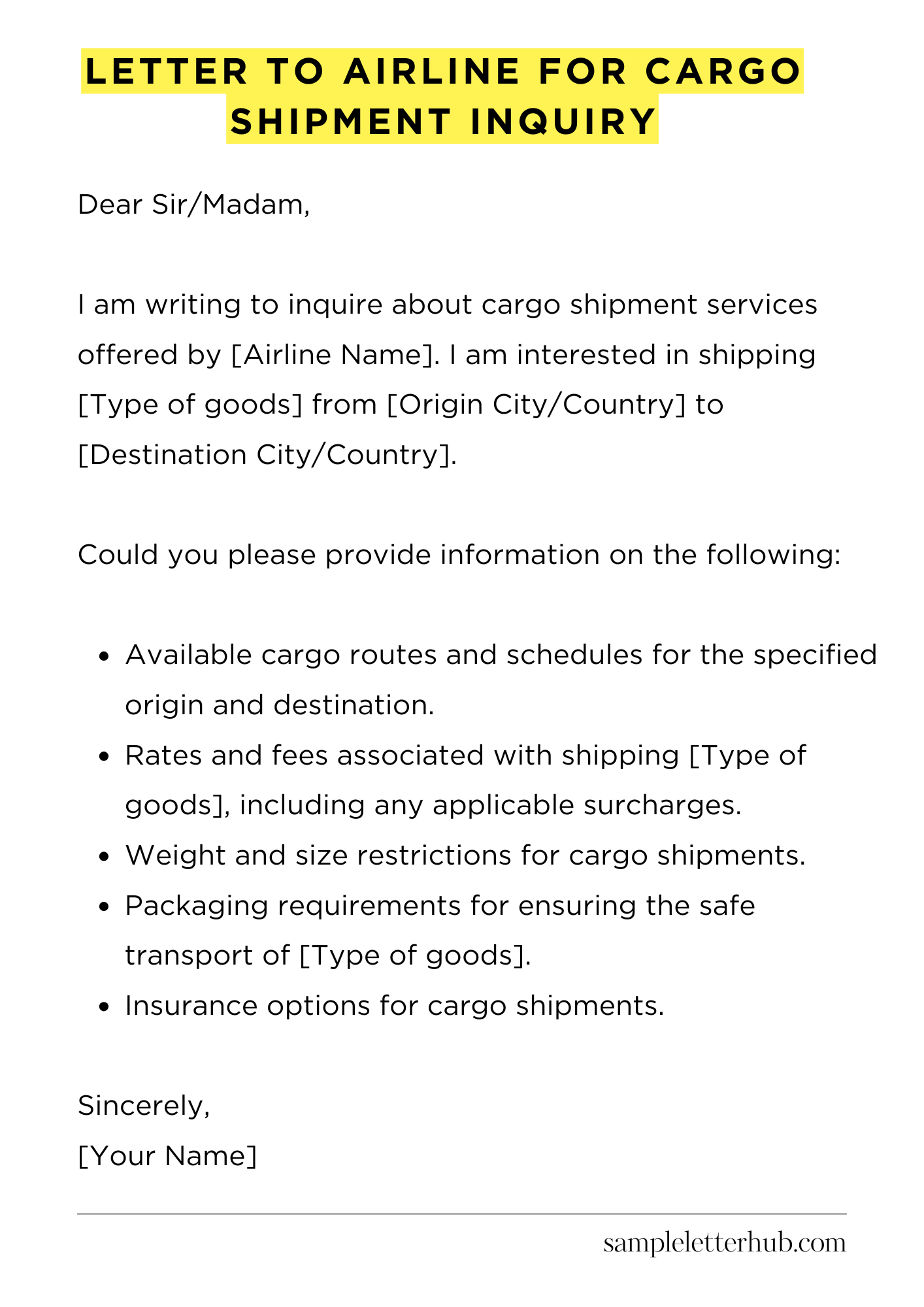
I am writing to inquire about cargo shipment services offered by [Airline Name]. I am interested in shipping [Type of goods] from [Origin City/Country] to [Destination City/Country].
Could you please provide information on the following:
- Available cargo routes and schedules for the specified origin and destination.
- Rates and fees associated with shipping [Type of goods], including any applicable surcharges.
- Weight and size restrictions for cargo shipments.
- Packaging requirements for ensuring the safe transport of [Type of goods].
- Insurance options for cargo shipments.
- Required documentation for international cargo shipments.
If possible, I would appreciate it if you could provide a quotation based on the following details:
- Approximate weight of shipment: [Weight]
- Approximate dimensions of shipment: [Dimensions]
- Desired delivery date: [Date]
Thank you for your time and attention to this matter. I look forward to hearing from you soon.
Sincerely,
[Your Name]
How to Write Letter To Airline For Cargo Shipment Inquiry
1. Crafting a Compelling Subject Line
The subject line is your initial foray. It must be concise and immediately signal the letter’s purpose. Avoid ambiguity; clarity is paramount.
- Use keywords like “Cargo Inquiry,” “Shipment Details,” or “Freight Information.”
- Include your tracking number if available: “Cargo Inquiry – Tracking # [Your Tracking Number].”
- Be specific about the origin and destination, if pertinent: “Cargo Inquiry – [Origin City] to [Destination City].”
2. The Salutation: A Professional Overture
Begin with a formal salutation. This sets a respectful tone for the ensuing communication. Impersonal greetings are a faux pas.
- If you know the recipient’s name, use it: “Dear Mr./Ms. [Last Name],”
- If the recipient is unknown, use a general but professional greeting: “Dear Cargo Department,” or “To Whom It May Concern,”
- Avoid overly casual greetings like “Hi” or “Hello.”
3. Introductory Paragraph: Setting the Stage
The opening paragraph should succinctly state your purpose. Immediately convey why you are writing and what information you seek. Avoid circuitous language.
- Clearly state that you are inquiring about a potential or existing cargo shipment.
- Mention any relevant details, such as the type of goods, approximate weight, or desired delivery timeframe.
- Example: “I am writing to inquire about the possibility of shipping [Type of Goods] weighing approximately [Weight] from [Origin City] to [Destination City] with an anticipated delivery date of [Date].”
4. Body Paragraphs: Delving into Specifics
This section constitutes the core of your inquiry. Provide all pertinent details and pose specific questions. Precision is crucial for a prompt and accurate response.
- Include detailed information about the cargo: dimensions, weight, special handling requirements (e.g., fragile, perishable).
- Ask specific questions about:
- Available shipping options and schedules.
- Cost estimates for different service levels.
- Insurance options and coverage details.
- Any restrictions or regulations applicable to your cargo.
- Required documentation for international shipments.
- Be meticulous; the more information you provide, the more accurate the response will be.
5. Providing Contact Information: Facilitating Communication
Ensure the airline can easily reach you. Include multiple contact methods for expediency. A lack of contact information is a cardinal sin.
- Provide your full name, phone number, and email address.
- If applicable, include your company name and address.
- Specify your preferred method of contact (e.g., “Please contact me via email”).
6. Concluding Paragraph: A Courteous Farewell
End with a polite closing paragraph. Express your gratitude for their time and reiterate your expectation of a prompt response. A gracious exit leaves a positive impression.
- Thank the recipient for their time and consideration.
- Reiterate your anticipation of receiving the requested information.
- Example: “Thank you for your time and attention to this matter. I look forward to receiving your response at your earliest convenience.”
7. The Closing: Formalities and Finery
Use a professional closing. This is the final touch, reinforcing the formal tone of your letter. Inappropriate closings can undermine your credibility.
- Use a formal closing such as “Sincerely,” or “Respectfully,”
- Followed by your full name.
- If sending a hard copy, leave space for your signature above your typed name.
Frequently Asked Questions: Cargo Shipment Inquiry Letters
This section addresses common queries regarding writing inquiry letters to airlines for cargo shipments. It aims to provide clarity and guidance on the essential aspects of such correspondence.
What information should I include in my cargo shipment inquiry letter?
Your letter should include the origin and destination of the shipment, the type and quantity of goods, the desired delivery timeframe, and any specific handling requirements.
Who should I address the inquiry letter to at the airline?
Address your letter to the cargo department or the cargo sales manager. If the specific name is unknown, use a general title like “Cargo Department Manager.”
How do I inquire about cargo rates and fees?
Clearly state your request for a detailed breakdown of all applicable rates, fees, and surcharges associated with your proposed cargo shipment.
What is the best way to follow up on my inquiry letter?
Allow a reasonable timeframe for a response (typically 3-5 business days). If you haven’t received a reply, follow up with a polite email or phone call referencing your initial letter.
Should I include my contact information in the letter?
Yes, provide your full name, company name (if applicable), phone number, and email address to ensure the airline can easily contact you with a response.
Related:
Resignation letter due to rude boss
Resignation letter moving to another state
Resignation letter due to illness of family member
Resignation letter due to study