

A “Letter To Airline For Seat Assignment Request” is a formal way to ask an airline for a specific seat. People write these letters when they have special needs. They also write them when they want to sit with family.
Need to write such a letter? We have you covered. This article provides templates and examples. These samples will make writing your letter easy.
We offer various samples. These help you tailor your request. Get the seat you want with our help.
Letter To Airline For Seat Assignment Request
[Your Name]
[Your Address]
[Your Phone Number]
[Your Email Address]
[Date]
[Airline Name]
[Airline Address]
Subject: Seat Assignment Request – Booking Reference [Your Booking Reference Number]
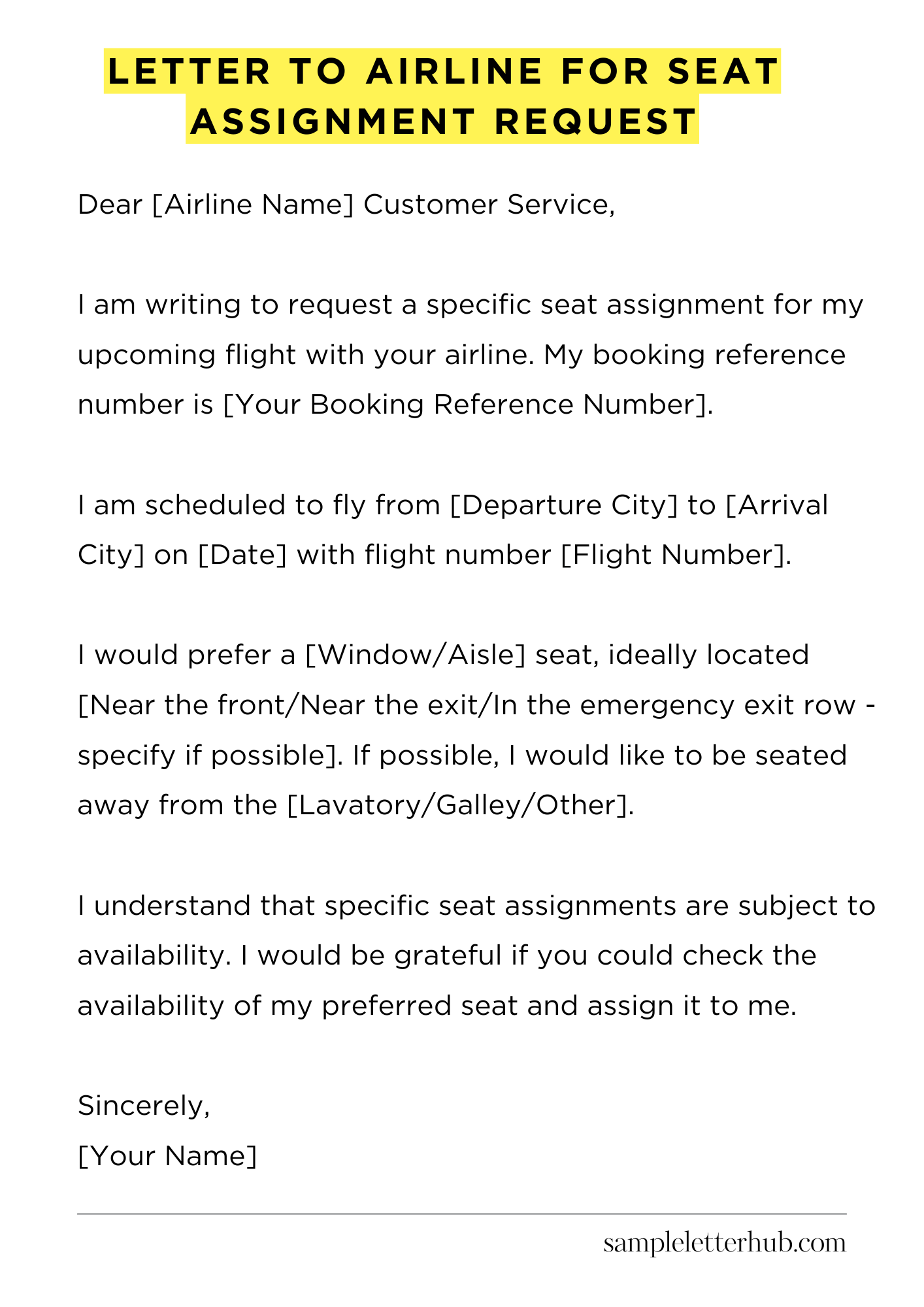
Dear [Airline Name] Customer Service,
I am writing to request a specific seat assignment for my upcoming flight with your airline. My booking reference number is [Your Booking Reference Number].
I am scheduled to fly from [Departure City] to [Arrival City] on [Date] with flight number [Flight Number].
I would prefer a [Window/Aisle] seat, ideally located [Near the front/Near the exit/In the emergency exit row – specify if possible]. If possible, I would like to be seated away from the [Lavatory/Galley/Other].
I understand that specific seat assignments are subject to availability. I would be grateful if you could check the availability of my preferred seat and assign it to me.
Thank you for your time and assistance.
Sincerely,
[Your Name]
How to Write Letter To Airline For Seat Assignment Request
Subject Line: Capturing Attention From the Get-Go
- Be succinct: “Seat Assignment Request – [Your Name] – Booking Ref: [Your Booking Reference]” is often sufficient.
- Clarity is paramount; avoid ambiguity. The airline should immediately understand the purpose of your missive.
- Consider adding flight details (date and flight number) for expediency.
Salutation: Initiating Courteously
- Avoid overly familiar greetings. “Dear [Airline Name] Customer Service,” or “To Whom It May Concern,” are both suitable.
- If you know a specific contact, addressing them directly is always preferable.
- Maintain a professional tone from the outset.
Introduction: Stating Your Purpose with Finesse
- Clearly state your booking reference, flight number, and travel dates. This is non-negotiable.
- Articulate your seat request explicitly. For instance, “I am writing to formally request a seat assignment for the aforementioned flight.”
- Briefly mention any extenuating circumstances, such as medical needs or mobility issues, that necessitate a specific seat.
Body: Elucidating Your Seat Preferences
- Be specific. Instead of “a good seat,” request “an aisle seat near the front of the aircraft.”
- Justify your request, if necessary. “Due to a pre-existing back condition, I require an aisle seat for easier movement during the flight.”
- Offer alternatives. “If my preferred seat is unavailable, I would appreciate any aisle seat or a window seat in the front half of the plane.”
- Keep the tone polite and reasonable. Airlines are more amenable to accommodating courteous requests.
Justification: Substantiating Your Plea
- This section is crucial if you have a compelling reason for your request (medical, disability, etc.).
- Provide supporting documentation if possible. A doctor’s note, for example, can bolster your claim.
- Emphasize the importance of the seat assignment to your overall travel experience.
- Avoid being overly demanding or entitled. Frame your request as a need, not a demand.
Closing: Reaffirming Gratitude and Expectations
- Express your appreciation for their consideration. “Thank you for your time and attention to this matter.”
- Reiterate your contact information (phone number and email address) for easy follow-up.
- Indicate your anticipation of a favorable response. “I look forward to hearing from you soon regarding my seat assignment.”
- Use a professional closing such as “Sincerely,” or “Best regards,” followed by your full name.
Proofread: Ensuring Impeccable Communication
- Before dispatching your letter, meticulously proofread it for any grammatical errors or typos.
- Ensure the tone is consistently polite and professional throughout the communication.
- Double-check all factual information, such as flight numbers and booking references, for accuracy.
- A well-crafted letter reflects positively on you and increases the likelihood of a favorable outcome.
Frequently Asked Questions: Airline Seat Assignment Requests
This section addresses common inquiries regarding seat assignment requests made directly to airlines. Understanding the process can improve your chances of securing your preferred seating.
Why should I write a letter to request a specific seat assignment?
Writing a letter allows you to formally document your request, especially when dealing with special needs, medical conditions, or other circumstances that require specific seating arrangements. It provides a written record of your request and can be referenced later if necessary.
When is the best time to send a seat assignment request letter?
Ideally, send your request as soon as you book your flight. This allows the airline ample time to consider your request and potentially accommodate your needs. Follow up closer to the departure date to confirm the status of your request.
What information should I include in my seat assignment request letter?
Include your full name, booking reference number (PNR), flight number, date of travel, and a clear and concise explanation of your seat preference and the reason for your request. If applicable, provide supporting documentation, such as a doctor’s note.
To whom should I address the seat assignment request letter?
Address the letter to the airline’s customer service department or the special assistance team. You can usually find the appropriate contact information on the airline’s website.
What are the chances of my seat assignment request being granted?
The likelihood of your request being granted depends on several factors, including seat availability, your frequent flyer status, and the specific reason for your request. While airlines strive to accommodate passengers’ needs, seat assignments are ultimately subject to availability and operational constraints.
Related:
Resignation letter due to rude boss
Resignation letter moving to another state
Resignation letter due to illness of family member
Resignation letter due to study